


Schwindgasse 8 – Luftwaffe Court and Reichs Court-Martial (Reichkriegsgericht)
Beginning in 1938, a large Luftwaffe Court was located in the building on Schwindgasse 8, which was later joined by a branch of the Reichs Court-Martial. As courts within the National Socialist system of military justice, these courts were part of an unjust criminal regime that persecuted deserters, self-mutilators, saboteurs, conscientious objectors and others.

Letterhead on a letter from the Luftgau court to a prison in Vienna, 1942 (source: DÖW).
Establishment of the Luftgau Court
A ‘Luftgau’ or ‘aerial region’ was an administrative and supply organization of the Luftwaffe limited to a fixed geographical area. The Luftwaffe Court moved into the building on Schwindgasse 8 immediately following the Anschluss in 1938. The close physical proximity to other important Luftwaffe offices was advantageous (Air Fleet 4 or ‘Luftflottenkommando 4’) was located on Schwarzenbergplatz, while the Luftgaukommando XVII was located on Schillerplatz. Starting in 1938, the court began operating under the name „Feldgericht des Luftgaus XVII“, and was also known later as the „Feldgericht des kommandierenden Generals und Befehlshabers im Luftgau XVII“. (Court of the General and Military Commander of ‘Luftgau XVII’).
Jurisdiction and Size
The Luftgau XVII encompassed a large geographical region and was largely comprised of today’s Austria and Czech Republic. All Luftwaffe members – officers, soldiers as well as numerous civilians, were subject to the jurisdiction of the Luftgau Court, unless a more specialized court was competent for a particular case. The court also maintained branches, for example, in Linz and Brno. Up to eight judges worked at the same time at the court, which was led by a presiding judge. Judgments issued by the court had to be signed by the top officials of the court – the respective Luftwaffe commanders, who were generally located nearby in the above-mentioned garrison headquarters.

Excerpt from a notice of legal proceedings against members of a Styrian resistance group (OFF) regarding a court trial on Schwindgasse 8 (source: DÖW 21062/85C)
Reichs Court-Martial (Reichskriegsgericht)
The Reichs Court-Martial (RKG) was established in Berlin in 1936, and expanded its jurisdiction to include Austria following the Anschluss in 1938. Prior to the outbreak of war in 1939, it was primarily responsible for appeal proceedings, as well as proceedings related to treason and high treason. Some of its decisions served as directives, and were thus binding on other military courts. In mid-August, 1943, the court moved from Berlin to Torgau. The 4th Senate of the RKG was established in 1941, and beginning in the fall of 1944, it convened occasionally in the Schwindgasse in Vienna. The Reichs Court-Martial investigated over 10,000 cases, with charges being brought in about half of the cases.
Competence of the Reichs Court-Martial
The RKG was responsible for specific offenses, irrespective of whether they were committed by soldiers or civilians. It was primarily competent for offenses including treason, high treason, military treason, attacks on the Führer and Chancellor of the Reich, and in certain cases for undermining military morale. A particularly large number of cases involving religious and political conscientious objectors landed before the RKG.
Legal Practice of the Reichs Court-Martial
Of the 1,189 death sentences that were pronounced by the court, 1,049 were carried out, most related to espionage (340), high treason (313) and the subversion of the war effort (313); the judgments involved civilians more than military personnel (689 vs. 500). The majority of the military personnel served with the army (422).

The Bulgarian Embassy today. (Mathias Lichtenwagner)
Termination of Both Courts
At the end of March, 1945, the Luftwaffe Court was transferred to Upper Austria, where it moved into quarters located in Linz and Stadl-Paura near Lambach. The Reichs Court-Martial was probably transferred out of the Schwindgasse location at the same time. In 1945, a judicial inquiry pursuant to the War Crimes Law was launched against the judges and employees of the Luftwaffe Court located on Schwindgasse. By mid-1947, however, all the defendants were released and all proceedings were terminated. While the judges stated on record that they had passed dozens of death sentences against deserters and persons found guilty of subverting the war effort, there were never any consequences for their actions. Bulgaria’s diplomatic mission has occupied the building since 1957.
Case Study:
On 11th March, 1945, Karl and Edgar Ulsamer were sentenced to death by the Reichs Court-Martial located on Schwindgasse, but succeeded in escaping detention during the evacuation of the Wehrmacht Detention Center (Wehrmachtsuntersuchungsgefängnis or ‘WUG X’).
(Many thanks to Peter Rand for the translation.)
Gedenkfeier beim Deserteursdenkmal
Am 1.9.2017 fand am Ballhausplatz beim Deserteursdenkmal eine Gedenkfeier statt zu der sich, trotz sich ankündigendem und dann auch aufziehenden Regen, rund 50 Personen eingefunden haben. Wir geben im folgenden die Einladung wieder:
Gedenkfeier beim Deserteursdenkmal – Im Gedenken an die Verfolgten und Opfer der NS-Militärjustiz
“Vielleicht kommt einmal eine Zeit, wo man sich dafür nicht mehr zu schämen braucht.”
Am 1. September 1939 überfiel das Deutsche Reich Polen und begann damit den Zweiten Weltkrieg. Während der nächsten sechs Jahre kämpften österreichische Soldaten Seite an Seite mit ihren „reichsdeutschen“ Kameraden. Für alle „anderen“ bedeutete dies die Diffamierung: für die ungehorsamen Soldaten, die Deserteure und “Selbstverstümmler“, die Zivilisten und Zivilistinnen, die als „Wehrkraftzersetzer“ oder „Kriegsverräter“ verfolgt, gefoltert, verurteilt und hingerichtet wurden. Das Personenkomitee »Gerechtigkeit für die Opfer der NS-Militärjustiz« und die Grünen setzten sich über Jahre für ein Deserteursdenkmal ein, am 24.10.2014 wurde es am Ballhausplatz feierlich eröffnet.
Die Grünen Wien – Die Grüne Alternative und der Grüne Klub im Rathaus laden daher anlässlich der 78. Wiederkehr des Tages des Überfalls der Deutschen Wehrmacht auf Polen zur 3. Gedenkveranstaltung am Ballhausplatz ein.
1.September 2017, 13.30 Uhr, Ballhausplatz
Redebeiträge von:
– David Ellensohn, Klubobmann im Grünen Rathausklub
– Sigrid Maurer, Abgeordnete zum Nationalrat
– Festrede: Friedrun Huemer, Obfrau HEMAYAT

-

- Gedenkfeier Ballhausplatz 2017: Redebeitrag David Ellensohn, daneben Friedrun Huemer, Sigi Maurer
-
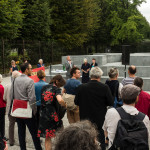
- Gedenkfeier Ballhausplatz 2017
-
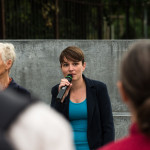
- Gedenkfeier Ballhausplatz 2017: Redebeitrag Sigi Maurer, daneben Friedrun Huemer
-

- Gedenkfeier Ballhausplatz 2017: Redebeitrag Sigi Maurer, daneben Aktivistinnen des KZ-Verbands
-

- Gedenkfeier Ballhausplatz 2017: Redebeitrag Sigi Maurer
-

- Gedenkfeier Ballhausplatz 2017: Aktivistinnen des KZ-Verbands
-

- Gedenkfeier Ballhausplatz 2017: Redebeitrag Friedrun Huemer
-

- Gedenkfeier Ballhausplatz 2017: Redebeitrag Friedrun Huemer
-

- Gedenkfeier Ballhausplatz 2017: Redebeitrag Friedrun Huemer
-
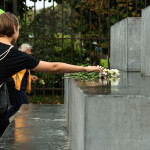
- Gedenkfeier Ballhausplatz 2017: TeilnehmerInnen legen die mitgebrachten Blumen am Denkmal ab
-
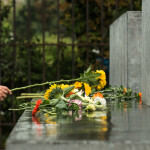
- Gedenkfeier Ballhausplatz 2017: TeilnehmerInnen legen die mitgebrachten Blumen am Denkmal ab
-

- Gedenkfeier Ballhausplatz 2017: Richard Wadani begrüßt TeilnehmerInnen
-

- Gedenkfeier Ballhausplatz 2017: Peter und Friedrun Huemer
-
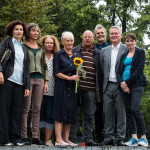
- Gedenkfeier Ballhausplatz 2017: Alev Korun, Birgit Hebein, Monika Vana, Friedrun Huemer, Niki Kunrath, Martin Margulies, David Ellensohn, Sigi Maurer
-

- Gedenkfeier Ballhausplatz 2017: Die mitgebrachten Blumen am Denkmal nach der Gedenkfeier
-

- Gedenkfeier Ballhausplatz 2017: Die mitgebrachten Blumen am Denkmal nach der Gedenkfeier
-

- Gedenkfeier Ballhausplatz 2017: Die mitgebrachten Blumen am Denkmal nach der Gedenkfeier
Die Fotos von der Veranstaltung wurden uns für diese Seite freundlicherweise von Patrick Zöchling zur Verfügung gestellt. Wer sie verwenden will, möge sich an ihn wenden.
Von Renate Sassmann wurde im Zuge der Feier ein kurzes Interview mit Richard Wadani geführt, das wir ebenso verlinken möchten:
6. Mai 2017: Gedenk- und Befreiungsfeier: Richard Wadani spricht in Greifenburg
Mit 95 Jahren ist Richard Wadani einer der letzten Zeitzeugen des Widerstandes von Wehrmachtsdeserteuren gegen das NS-Regime. Er spricht am Samstag, den 6. Mai bei der Gedenk- und Befreiungsfeier am Denkmal für die Verfolgten des NS-Regimes am Bahnhof in Greifenburg. Der Künstler Hans-Peter Profunser wird eine neue Serie von Kunstdrucken zum Thema Widerstand und Verfolgung präsentieren, die in einer limitierten Auflage von 149 Stück erscheinen. Die Kunstdrucke sind gegen eine Spende erhältlich, die in die Erhaltung des Denkmals fließt.
Begrüßung: Bürgermeister Josef Brandner
Szenische Lesung: SchülerInnen der HLW Spittal/Drau
Rede: Richard Wadani, Wehrmachtsdeserteur
Präsentation: Hans-Peter Profunser, Kunstdrucke (neue Serie)
Musik: Jan Kubis (Akkordeon), Marjetka Luznik (Gesang)
Samstag, 6. Mai 2017,17.00 Uhr
Denkmal für die NS-Opfer, Greifenburg (Bahnhof)
Mehr Informationen: www.aegide.at
Rückfragen: Dr. Peter Pirker Obmann Verein aegide 0676 327 28 33
Demokratiepreis des Parlaments an Personenkomitee verliehen
Am 13.2.2017 wurde der Demokratiepreis 2016 der Margaretha-Lupac-Stiftung im Parlament überreicht. Ausgezeichnet wurden drei Vereine bzw. Institutionen:
- Das Ludwig Boltzmann Institut für Menschenrechte (Link),
- das Freie Radio Salzkammergut (Link),
- sowie das “Personenkomitee ‘Gerechtigkeit für die Opfer der NS-Militärjustiz'”.
Einer Rede der Präsidentin des Nationalrats Doris Bures folgten drei Festreden zur Verleihung von Manfried Welan, Brigitte Bierlein und Klaus Unterberger für die drei ausgezeichneten Projekte. Dem folgten Dankesreden im Namen der Projekte durch Patricia Hladschik (für das Boltzmann-Institut), Thomas Geldmacher (für das Personenkomitee) und Mario Friedwagner (für das Freie Radio Salzkammergut). Details der Reden könnten der Presseaussendung des Parlaments entnommen werden. Bei Gelegenheit reichen wir die Redetexte nach.
-

- Wegweiser zur Preisverleihung im Parlament (Fotorechte: Parlament)
-
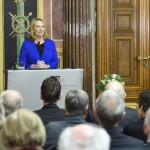
- NR-Präs. Doris Bures begrüßt die Festgäste. (Fotorechte: Parlament)
-

- Manfried Welan bei der Festrede für das Personenkomitee. (Fotorechte: Parlament)
-
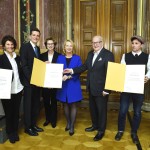
- Überreichung der Urkunden an die drei PreisträgerInnen. (Fotorechte: Parlament)
-

- Thomas Geldmacher (Personenkomitee) bei seiner Dankesrede. (Fotorechte: Parlament)
-

- Thomas Geldmacher (Personenkomitee) bei seiner Dankesrede. (Fotorechte: Parlament)
-

- Nochmal alle PreisträgerInnen, die Präsidentin des Nationalrates und die FestrednerInnen. (Fotorechte: Parlament)
-

- Präsidentin des Nationalrates und die PreisträgerInnen. (Fotorechte: Parlament)
-
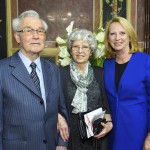
- Richard Wadani, Linde Wadani und die Präsidentin Bures. (Fotorechte: Parlament)
Das Personenkomitee
Personenkomitee „Gerechtigkeit für die Opfer der NS-Militärjustiz“:
Beschreibung ist der Bewerbung zum Demokratiepreis der Margaretha-Lupac-Stiftung des österreichischen Parlaments entnommen.
Seit 2002 engagiert sich das Personenkomitee „Gerechtigkeit für die Opfer der NS-Militärjustiz“ für die umfassende Rehabilitierung und Entschädigung der Wehrmachtsdeserteure, der „Wehrkraftzersetzer“ und Kriegsdienstverweigerer. Die Opfer der NS-Militärjustiz, Männer und Frauen, Soldaten und Zivilist_innen, darunter Widerstandskämpfer_innen aus ganz Europa, galten zu diesem Zeitpunkt als „Verräter“, als „Verräterinnen“ oder „Feiglinge“. Zu Beginn des neuen Jahrtausends interessierten sich weder die historische Forschung noch politisch-gesellschaftliche Initiativen für Geschichte oder Gegenwart dieser Menschen. Das Personenkomitee agierte von Anfang an auf unterschiedlichen Ebenen und verbindet – bis heute – auf breiter Basis zivilgesellschaftliches Engagement mit intensiver parlamentarischer Arbeit, mit medialer und kulturpolitischer Vermittlungstätigkeit. Die Basis dieser Aktivitäten bilden eine von den Mitgliedern des Personenkomitees überhaupt erst initiierte wissenschaftliche Expertise und rege Publikationstätigkeit.
Hervorgegangen ist das Personenkomitee aus einer Initiative von Studierenden der Universität Wien Ende der 1990er Jahre. Im Laufe der Jahre hat es sich zu einem weithin geachteten zivilgesellschaftlichen Akteur entwickelt, der ein bis dahin unbearbeitetes Thema benannt und die berechtigten Interessen einer Minderheit vor allem in den ersten Jahren gegen den gesellschaftlichen Mainstream durchgesetzt hat. Unterstützt wurde das Personenkomitee dabei von Institutionen der Zivilgesellschaft (Verbände der Opfer des Nationalsozialismus, Religionsgemeinschaft u. a.), von politischen Aktivist_innen, Kulturschaffenden, Journalist_nnen und Politiker_nnen, anfangs vor allem der Grünen, später auch von SPÖ und ÖVP. Insbesondere im Rahmen einer „Wortspendenkampagne“ für die Ausstellung „Was damals Recht war …“ – Soldaten und Zivilisten der Wehrmacht und später ein Deserteursdenkmal in Wien gelang es dem Personenkomitee, eine Koalition zu schmieden, die von Kardinal Christoph Schönborn über den ehemaligen Adjutanten des Bundespräsidenten General a. D. Hubertus Trauttenberg bis hin zum ehemaligen steirischen KPÖ-Chef Ernest Kaltenegger reichte. Namhafte Kulturschaffende wie Literaturnobelpreisträgerin Elfriede Jelinek oder der Schauspieler Josef Hader komplettierten diese Allianz.
Nicht zuletzt aufgrund der Zusammenarbeit verschiedener gesellschaftlicher Akteur_innen ist der ursprüngliche Forderungskatalog des Personenkomitees aus dem Jahre 2002 heute umfassend umgesetzt. Die Umsetzung lässt sich am besten entlang der wichtigsten politischen Beschlüsse des Parlaments und anderer politischer Körperschaften nachzeichnen: die wissenschaftliche Aufarbeitung der Schicksale der österreichischen Opfer der NS-Militärgerichtsbarkeit, die sozialrechtliche Gleichstellung der Verfolgten der NS-Militärgerichte durch das Anerkennungsgesetz 2005, die endgültige Rehabilitierung durch den Beschluss des Aufhebungs- und Rehabilitationsgesetzes 2009 und die Errichtung des Denkmals für die Verfolgten der NS-Militärjustiz am Wiener Ballhausplatz im Jahr 2014.
Sowohl die Gesetze als auch das Denkmal sind maßgeblich der Beharrlichkeit des Personenkomitees und insbesondere seines Ehrenobmannes, des ehemaligen Wehrmachtsdeserteurs Richard Wadani, zu verdanken.
Das Personenkomitee hat sich stets darum bemüht, wissenschaftliche Forschung mit parlamentarischer Arbeit zu koppeln und den Ergebnissen beider Tätigkeitsfelder massenmediale Präsenz zu verleihen. Diese Kombination ist zweifellos einer der Schlüssel für den Erfolg des Personenkomitees im Sinne der Demokratie und des Parlamentarismus in Österreich. Zahlreiche parlamentarische Anfragen und Anträge aus fünf Legislaturperioden, unzählige Zeitungsartikel, Radio- und Fernsehbeiträge, eine beträchtliche Anzahl von wissenschaftlichen Publikationen, eine mittlerweile an vier Standorten in Österreich präsentierte Ausstellung sowie Denkmäler in Wien und Bregenz zeugen von den Bemühungen um die Rehabilitierung der Opfer der NS-Militärjustiz. Erleichtert wurde diese Arbeit auch dadurch, dass zwei Mitglieder des Personenkomitees (ab 1998 Hannes Metzler, ab 2007 auch Thomas Geldmacher) als Referenten im Grünen Parlamentsklub tätig waren und es immer wieder Politiker_innen (nicht nur der Grünen) gab, die dem Thema gegenüber aufgeschlossen waren (seitens der Grünen etwa Andreas Wabl, Terezija Stoisits, Karl Öllinger, Stefan Schennach, Eva Glawischnig, Alexander Van der Bellen, Harald Walser, Albert Steinhauser und Wolfgang Zinggl, seitens der SPÖ Heinz Fischer, Barbara Prammer, Albrecht Konecny und Hannes Jarolim, seitens der ÖVP Andreas Khol und Fritz Neugebauer).
Die Akteur_innen des Personenkomitees (heute vor allem: die Politikwissenschaftler Thomas Geldmacher, Hannes Metzler, Mathias Lichtenwagner und Peter Pirker, der Historiker Magnus Koch, die Historikerin Lisa Rettl, die Kulturwissenschaftlerin Juliane Alton sowie Richard Wadani) haben ein jahrzehntelang ignoriertes Kapitel österreichischer Vergangenheitspolitik sichtbar gemacht, die anschließenden Diskussionen darüber maßgeblich geprägt und der Rehabilitierung der Opfer der NS-Militärjustiz immer wieder entscheidende Impulse gegeben. In der Folge hat sich zum einen das Bild des Deserteurs in der österreichischen Gesellschaft gewandelt; Österreichs politische Parteien haben ihre ursprünglich überwiegend ablehnenden Positionen zu den Wehrmachtsdeserteuren zum Teil drastisch geändert. Zum anderen hat insbesondere die historische Auseinandersetzung den Blick erweitert und ins Bewusstsein gerufen, dass der bisherige Verfolgtenbegriff weiter gefasst werden muss: von der Desertion hin zu verschiedensten Deliktformen, Handlungsmotiven und biografischen Hintergründen, von einer rein österreichischen Sicht hin zu einer europäischen Perspektive, die die Verfolgten in den von der Wehrmacht besetzten Länder mit einbezieht.
Seit der Eröffnung des Denkmals am Ballhausplatz sind die Opfer der NS-Militärjustiz auch symbolisch in der Mitte der österreichischen Gesellschaft angekommen. Die kontinuierliche Arbeit des Personenkomitees ist ein Beleg dafür, dass Demokratisierungs- und Aufklärungsbemühungen von Akteur_innen der Zivilgesellschaft politische Wirkung entfalten können. Rehabilitierung funktioniert nur, wenn sie öffentlich geschieht.
Die Geschichte des Personenkomitees
Es begann im Wintersemester 1998/99: Vier Studierende – Maria Fritsche (Geschichte), Hannes Metzler (Politikwissenschaft), Thomas Walter (Rechtswissenschaft) und Nina Horowitz (Politikwissenschaft) – interessierten sich im Rahmen des Seminars „Die Wehrmacht als Politikum. Ideologie – Struktur – Tätigkeit und Wirkungsgeschichte in Österreich“ für Geschichte und Gegenwart der österreichischen Wehrmachtsdeserteure. Sie schlugen das Thema ihrem Seminarleiter, dem Politikwissenschaftler Walter Manoschek, einem der Kuratoren der sogenannten ersten Wehrmachtsausstellung, für eine gemeinsame Seminararbeit vor.
Nach ersten Besuchen der Studierenden in den Archiven und Sichtung der Literatur stellte sich bald heraus, dass sich die historische Forschung in Österreich mit den Wehrmachtsdeserteuren noch kaum beschäftigt hatte. Der Jus-Student Thomas Walter etwa befasste sich mit der Frage, ob die Urteile der NS-Militärjustiz 1998 noch rechtskräftig und die verurteilten Deserteure oder „Wehrkraftzersetzer“ daher vorbestraft seien, und wandte sich daher in einem Brief an den damaligen Justizminister Nikolaus Michalek. Zur selben Zeit formulierte Hannes Metzler, zu diesem Zeitpunkt Mitarbeiter des Nationalratsabgeordneten der Grünen Andreas Wabl, eine ähnlich lautende parlamentarische Anfrage an den Justizminister. Aus den im Anschluss an diese Anfrage und deren Beantwortung im Frühjahr 1999 geführten parlamentarischen und öffentlichen Debatten resultierte im Juli des Jahres eine Entschließung des Nationalrates, in der dieser das Wissenschaftsministerium aufforderte, die Geschichte der österreichischen Opfer der NS-Militärgerichtsbarkeit erforschen zu lassen, um daraufhin die Aufhebung der Urteile von Amts wegen durchzuführen.
Aufgrund der Vorarbeiten der Jahre 1998/1999 erhielt eine Gruppe junger Wissenschaftler_innen um Walter Manoschek (David Forster, Maria Fritsche, Thomas Geldmacher, Hannes Metzler und Thomas Walter) den Zuschlag für ein Forschungsprojekt, das sich in den Jahren 2001–2003 den österreichischen Opfern der NS-Militärgerichtsbarkeit widmete. Diese Gruppe gründete das Personenkomitee „Gerechtigkeit für die Opfer der NS-Militärjustiz“, das sich am 11. Oktober 2002 konstituierte, dem 80. Geburtstag des ehemaligen Wehrmachtsdeserteurs und kritischen Begleiters des Forschungsprojektes Richard Wadani. Unter dem Titel „Späte Gerechtigkeit“ wurden in einem Forderungskatalog folgende Ziele formuliert:
1.) Die Aufhebung aller Urteile der Wehrmachtsjustiz und vergleichbarer Sondergerichte durch eine Entscheidung des Nationalrates
2.) Die Anerkennung von Haftzeiten in Konzentrationslagern und Gefängnissen als Ersatzzeiten für die gesetzliche Pensionsversicherung
3.) Die Anerkennung von Opfern der NS-Militärjustiz als Opfer des Nationalsozialismus und die Aufnahme dieser Personengruppe in das Versorgungs- und Entschädigungsrecht
4.) Die ideelle und finanzielle Förderung der historischen und politischen Aufarbeitung der NS-Militärjustiz durch die Republik Österreich
Richard Wadani, Sprecher des Personenkomitees, fügte diesen vier Punkten handschriftlich eine fünfte, zu diesem Zeitpunkt völlig unrealistische Forderung hinzu:
5.) Die Errichtung eines Denkmals für die Opfer der NS-Militärjustiz (Original hier)
Am 1. November 2002 führte das Personenkomitee seine erste von bisher 14 Gedenkveranstaltungen für die Opfer der NS-Militärjustiz beim Gedenkstein im Donaupark auf dem Gelände des ehemaligen Militärschießplatzes Kagran durch. In den Jahren 1940–1945 wurden dort hunderte Widerstandskämpfer und verurteilte Wehrmachtsangehörige erschossen.
Im Juni 2003 präsentierten Walter Manoschek und seine Mitarbeiter_innen im Rahmen des Symposiums „Österreichische Opfer der NS-Militärgerichtsbarkeit. Rehabilitation und Entschädigung“ die Ergebnisse ihres Forschungsprojektes im Abgeordneten-Sprechzimmer des Parlaments. Sowohl der seinerzeitige Erste Nationalratspräsident Andreas Khol als auch der Zweite Nationalratspräsident Heinz Fischer leiteten aus den publizierten Resultaten konkrete Handlungsoptionen für den Nationalrat ab. Dennoch dauerte es weitere zwei Jahre bis zum Beschluss des Anerkennungsgesetzes 2005, mit dem die Opfer der NS-Militärjustiz als Opfer des Nationalsozialismus anerkannt und deren sozialrechtliche Schlechterstellung beseitigt wurden. Dafür waren zwei Entwicklungen hauptverantwortlich. Zum einen forderte der mittlerweile zum Bundespräsidenten gewählte Heinz Fischer Ende 2004 und ein weiteres Mal im Jänner 2005 im Rahmen der Tagung „Widerstand in Österreich“ im Parlament einen „unmissverständlichen Akt des Gesetzgebers“, um die Urteile gegen die Opfer der NS-Militärjustiz aufzuheben. Er brachte auf diese Weise die moralische Autorität seines Amtes ins Spiel. Zum anderen entspann sich im April 2005 im Zuge der Behandlung einer Dringlichen Anfrage von Grünen und SPÖ im Bundesrat an die damalige Justizministerin Karin Miklautsch eine heftige Diskussion. In deren Verlauf gab der designierte Bundesratspräsident Siegfried Kampl (BZÖ, vormals FPÖ) zu Protokoll, Deserteure seien „zum Teil Kameradenmörder“ gewesen. Er beklagte zudem die „brutale Naziverfolgung“ nach 1945. Nicht zuletzt aufgrund des großen medialen Echos, das diese Äußerungen auslösten, ließ die Regierung um Bundeskanzler Wolfgang Schüssel das erwähnte Gesetz ausarbeiten, das noch vor der Sommerpause 2005 im Nationalrat beschlossen wurde.
Aus Sicht des Personenkomitees war das Anerkennungsgesetz, allen sozialrechtlichen Fortschritten zum Trotz, unbefriedigend, weil es die Frage der Rehabilitierung durch die Wiederverlautbarung zweier gesetzlicher Bestimmungen aus der unmittelbaren Nachkriegszeit (Aufhebungs- und Einstellungsgesetz 1945 und Befreiungsamnestie 1946) nicht abschließend klärte. Das Personenkomitee ließ es daher nicht dabei bewenden und plante die nächsten Schritte, um die endgültige Rehabilitierung voranzubringen.
Zu diesem Zweck gab sich das Personenkomitee 2008 formale Strukturen, gründete den Verein „Personenkomitee Gerechtigkeit für die Opfer der NS-Militärjustiz“ und suchte beim Nationalfonds der Republik Österreich für Opfer des Nationalsozialismus, beim Zukunftsfonds der Republik Österreich, bei der Stadt Wien und verschiedenen Bundesministerien um finanzielle Förderung an. Ziel war es, die 2007 in Berlin erstmals gezeigte, von der Stiftung Denkmal für die ermordeten Juden Europas entwickelte Wanderausstellung “‘Was damals Recht war …’ – Soldaten und Zivilisten vor Gerichten der Wehrmacht” in einer für österreichische Zwecke adaptierten Form in Wien zu präsentieren. Die erforderlichen umfangreichen inhaltlichen Änderungen am Ausstellungskonzept leisteten ausschließlich die Mitglieder des Personenkomitees, das außerdem ein umfangreiches Begleitprogramm konzipierte, gemeinsam mit dem Verein Gedenkdienst die pädagogische Begleitung der Besucher_innen in die Hand nahm sowie sich um Öffentlichkeitsarbeit und politisches Lobbying kümmerte.
Die Eröffnung dieser Ausstellung im Leopoldstädter Theater Nestroyhof Hamakom fand nicht zufällig am 1. September 2009 statt, dem 70. Jahrestag des Überfalls des Deutschen Reichs auf Polen. Als Hauptrednerin fungierte die damalige Nationalratspräsidentin Barbara Prammer, die in ihrer Festansprache die rasche umfassende gesetzliche Rehabilitierung der Opfer der NS-Militärjustiz ankündigte. Der damalige Zweite Nationalratspräsident Fritz Neugebauer konnte der Eröffnung aufgrund eines Auslandstermins zwar nicht beiwohnen, ließ sich aber am Nachmittag des 1. September, also noch vor der offiziellen Eröffnung, durch die Ausstellung führen und zeigte sich sehr an der Materie interessiert. Zugleich übernahm er gemeinsam mit Barbara Prammer, Verteidigungsminister Norbert Darabos sowie Bundespräsident Heinz Fischer den Ehrenschutz für die Ausstellung. Nationalratspräsidentin Barbara Prammer veranstaltete in Kooperation mit dem Personenkomitee am 18. September 2009 im Palais Epstein die Zeitzeug_innen-Veranstaltung „Störenfriede der Erinnerung“ mit Friedrich Cerha, Helga Emperger, Peter Kuchar, Hugo Pepper und Richard Wadani.
Die Ausstellung und die (auch international) umfangreiche mediale Berichterstattung brachten den Durchbruch: Am 7. Oktober 2009 präsentierten Justizministerin Claudia Bandion-Ortner sowie Hannes Jarolim, Heribert Donnerbauer und Albert Steinhauser, die Justizsprecher von SPÖ, ÖVP und Grünen, im Rahmen einer Pressekonferenz im Parlament einen Gesetzesvorschlag, der sich im Großen und Ganzen an einem Entwurf des Linzer Strafrechtsprofessors und langjährigen Unterstützers des Personenkomitees Reinhard Moos orientierte, den dieser Jahre zuvor im Auftrag der Grünen und des Personenkomitees verfasst hatte. Genau zwei Wochen später, am 21. Oktober 2009, wurde das Aufhebungs- und Rehabilitationsgesetz 2009 im Nationalrat mit den Stimmen von SPÖ, ÖVP und Grünen beschlossen. Zehn Jahre nach dem erstmaligen Auftauchen des Themas auf der politischen Agenda, nach zähen und aufgrund der politischen Konstellationen manchmal für Jahre festgefahrenen Verhandlungen wurde der parlamentarische Prozess zu Ende gebracht.
Nach den Wiener Gemeinderatswahlen im Jahr 2010 bemühte sich das Personenkomitee erfolgreich darum, im Koalitionsübereinkommen von SPÖ und Grünen einen Passus zu verankern, der die Realisierung eines „Mahnmals für Deserteure“ vorsah. Nach intensiv geführten Diskussionen, die sich insbesondere an der Frage des Standortes entzündeten, gab die Stadt Wien schließlich der Forderung des Personenkomitees nach und entschied, das Denkmal an einen zentralen Ort im Herzen der Republik, nämlich am Ballhausplatz, zu errichten. Der Berliner Künstler Olaf Nicolai entschied den geladenen Wettbewerb, der von KÖR Kunst im öffentlichen Raum GmbH durchgeführt wurde, und in dessen Jury auch zwei Mitglieder des Personenkomitees sowie – als beratende Stimme – Richard Wadani saßen, am 27. Juni 2013 für sich. Mehr als 69 Jahre nach Kriegsende, am 24. Oktober 2014, übergab Bundespräsident Heinz Fischer das Denkmal für die Verfolgten der NS-Militärjustiz im Rahmen eines Festaktes am Ballhausplatz der Öffentlichkeit.
Seither ist der Ballhausplatz ein Ort – und nicht länger bloß die leere Fläche zwischen Heldenplatz, Löwelstraße und Schauflergasse in der Wiener Innenstadt. (…)
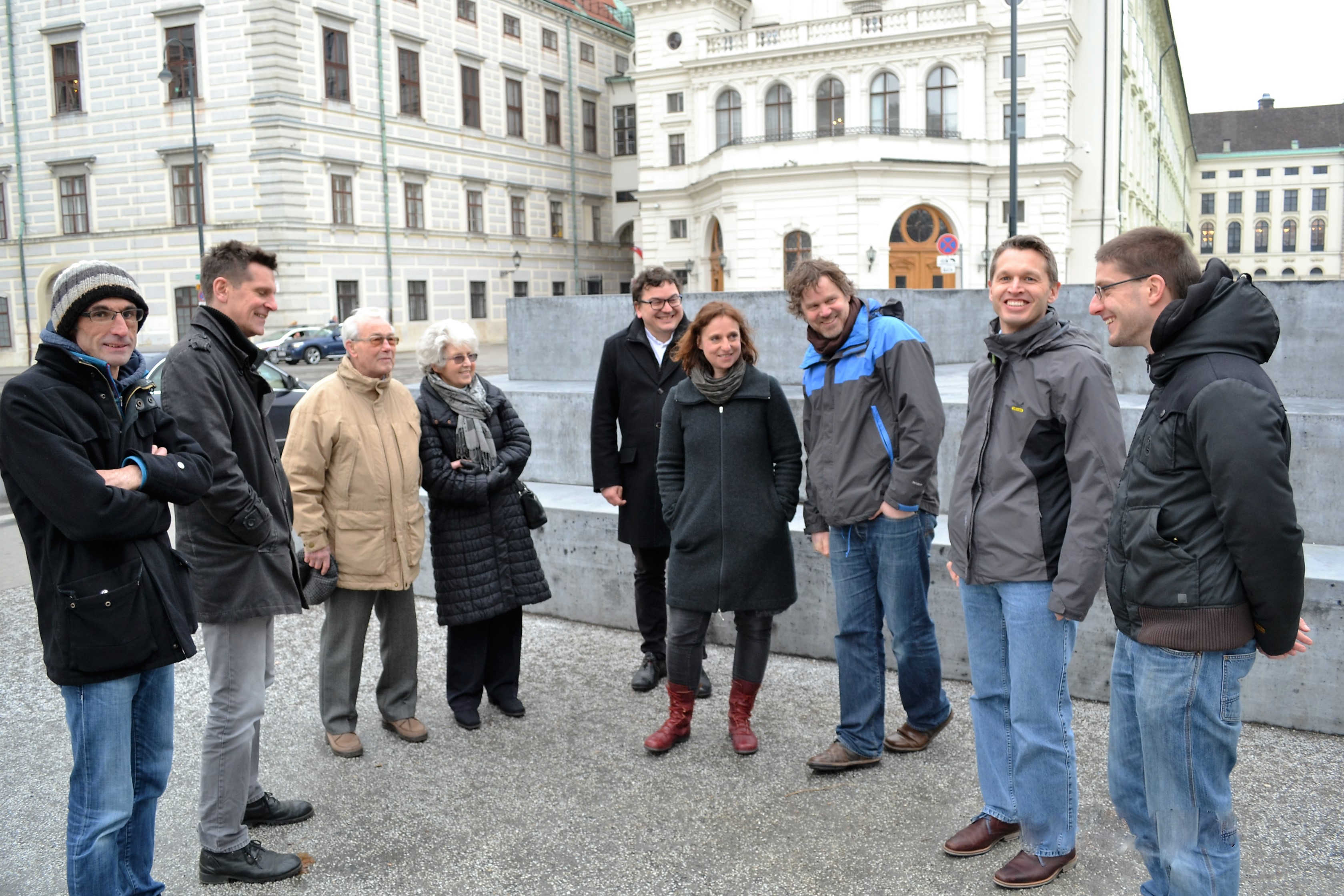
Einige Mitglieder des Personenkomitees vor dem Deserteursdenkmal am Ballhausplatz, Wien 2016.
Military Justice in Austria before 1938
MILITARY JUSTICE IN AUSTRIA BEFORE 1938
The basis for military criminal law of the Habsburg Monarchy were the military penal code from 1855 and the military penal procedure code dating back to the reign of Maria Theresa.
Trials against members of the Imperial and Royal Army were characterized by the lack of rights of the defendants. Only in July 1912 was a modern military penal procedure code adapted, which contained elements of the civil penal code, including the possibility of appealing against verdicts. With the beginning of World War I in 1914, the powers of the Austro-Hungarian military judiciary were significantly expanded.
Crimes such as treason, lèse majesté or the disturbance of public order were now tried by military judges, also known as »auditors«. The military judiciary of the Austro-Hungarian Army also served as a political instrument to deter and eliminate opposition – civilians too were tried before military courts. The total number of death sentences meted out by the Austro-Hungarian military judiciary is not known, but is said to have increased considerably between 1914 and 1918. In total, about three million people were court-martialed – this number roughly corresponds to the number of trials carried out by Wehrmacht courts. Within the postwar borders of Austria alone 162,000 cases were tried between 1914 and 1918.
First Republic
The defeat of 1918 brought about the end of monarchy in both Germany and Austria. On November 12, 1918, the democratic Republic of German-Austria was founded. Since the peace treaty of St. Germain prohibited the state’s planned accession to the new German Republic, it was officially renamed »Republic of Austria« on October 21, 1919. The democratic revolutions of 1918/1919 also entailed the end of military justice. A law passed on July 15, 1920 placed all army members under civil jurisdiction. A further law regulated the transfer of employees of the military judiciary to the civil judicial service. These provisions remained in force until 1934. The Austro-fascist dictatorship reintroduced military justice and established a military tribunal. The Austrian Army was used to combat the »enemy within« more and more frequently from the early 1930s on. The primary targets were Social Democrats as well as terrorist National Socialist groups, who were de facto the reason for the reintroduction of military justice.
The path to a “political soldier”
The Catholic-fascist governments under Engelbert Dollfuß and his successor Kurt Schuschnigg found little support in the Austrian public. The government struggled not only with the Social Democrats, who were banned in 1934, but also with the Nazi party, which had been operating illegally since 1934. The party radicalized its agitation to parallel the political developments in Germany: In January 1933, Adolf Hitler had been appointed Reich Chancellor and the National Socialists had dismantled the democratic state within only a few months. Already in May 1933, military jurisdiction was reintroduced; universal conscription applied from 1935 on. The »political soldier«, committing his life to »the leader and the people«, became a model in the German Reich. Leaders of the military judiciary immediately began to adjust military criminal law to the requirements of the planned war. Important instruments to this purpose were the decree on wartime special criminal law and the wartime criminal procedure code, which were both carried into effect shortly before the war began in 1939. Both granted military prosecutors nearly infinite possibilities of taking action against »enemies without and within«. The group of persons considered as such became ever larger as the war progressed.
Austria’s »Anschluss« to the German Reich
The annexation of Austria by the German Reich came as no surprise. At the beginning of 1938, political power had shifted in favor of the National Socialists. On March 11, two days after chancellor Kurt Schuschnigg had announced a referendum on Austria’s independence, the local NSDAP organized large-scale demonstrations in all the provinces, storming and occupying the regional seats of power. That same evening, Austrian president Wilhelm Miklas appointed the National Socialist minister of the interior Arthur Seyß-Inquart chancellor. The marching in of German troops on the morning of March 12 resembled a victory parade. The next day, the cabinet under Seyß-Inquart passed the »Constitutional law on the reunification of Austria with the German Reich«, and on March 15, Adolf Hitler gave a speech on Vienna’s Heldenplatz in front of cheering crowds. The Austrian Army was promptly subordinated to the German Wehrmacht. Within a few days, the new authorities dismissed 14 generals and about 50 staff officers. Until the end of 1938, some 18 percent of Austrian officers were retired, while 1,600 members of the officer corps continued their careers in the ranks of the Wehrmacht. It is to be assumed that Austrian lawyers were incorporated into the judicial apparatus of the Wehrmacht in the same manner.
Important Provisions
Important Provisions of Military Law during the »Third Reich«
New Military Law for a New War
After coming to power in 1933, the new Reich government under Adolf Hitler began destroying the constitutional independence of the judiciary. At the same time, the regime and its leading jurists set out to change the legal norms in force. Military justice was reintroduced in May 1933 and adapted to the new set of conditions. The objective was to create a new criminal law that would be stricter and harsher than the provisions in force between 1914 and 1918 – the Nazis partly blamed a supposedly lax military judiciary for the German defeat in World War I. This is why military jurists developed legal principles geared towards the »Führer state«. Adolf Hitler’s will was to be the »highest legal asset«. The ultimate goal was not finding the truth, but winning the war. Nazi criminal law theory no longer considered an offense the wrongdoing of an individual, but damage to the community. One of the questions to be considered before court was whether the defendant could remain part of the »national (völkisch) defense community«.
The »Wartime Special Criminal Law Decree«
In January 1936, experts presented the draft of a new military penal code; it was to replace the one that had been in force since 1898. This undertaking was later abandoned, as the code was considered not National Socialist enough, despite the fact that there were leading Nazi jurists on the responsible committee in the »Academy for German Law«. Instead, the Wehrmacht armed forces high command had a new abbreviated wartime criminal law written in the course of preparations for the invasion of Czechoslovakia in the summer of 1938, the »Wartime Special Criminal Law Decree«. At the same time, another decree significantly modified wartime criminal proceedings. Both decrees, makeshift at first, made military law radically harsher. The decrees remained confidential while Germany prepared mobilization and entered into force, just prior to the invasion of Poland, on August 26, 1939 – both in Germany and »annexed« Austria.
»Undermining the Military Forces«
One of the central provisions of the Wartime Special Criminal Law Decree pertained to the offense outlined in paragraph 5: »undermining the military forces«. It ruled on how to deal with criminal offenses that, according to the German leadership, had been punished too laxly during World War I, contributing to the »signs of disintegration« in 1918. The new provisions on »undermining the military forces« contained regulations previously found under »inducement to desertion«, »incitement to insubordination«, »insubordination or defiance«, »self-mutilation« and »evasion of service through deceit« in the military penal code. Previously, these offenses were penalized with prison or death sentences, as long as they had taken place »in the field« – however, death sentences were not meted out as a regular punishment. The new Wartime Special Criminal Law Decree now introduced the threat of a death sentence as a general rule. The personal motivations of the defendant were considered marginal, the »maintenance of discipline« and apparent needs of the »national community« came into focus. The paragraph was made more stringent even further during the war. Beginning in March 1943, for example, the regular penalty range could be exceeded if the »healthy national sentiment« called for it.
Adolf Hitler’s Directive from April 14, 1940
Shortly before the military campaign against France and the Benelux countries, the »Führer« and commander-in-chief of the Wehrmacht Adolf Hitler issued new guidelines for the punishment of deserters and those »undermining the military forces«. They defined under which circumstances a death sentence could be handed down, but also stated when mitigating circumstances should be taken into account. Countless verdicts speak to the importance of this directive, at the same time showing the leeway available to judges. The judges could decide whether »youthful injudiciousness« or »difficult domestic circumstances« were applicable as mitigating circumstances. Legal commentaries and instructions required that the »personality indicators« of a defendant be examined to establish whether the case at hand involved »criminal activity«. If defendants were considered »asocial« in the National Socialist meaning, they would frequently be sentenced to death. In such cases in particular, not just the offense but the »offender personality« was judged.
Further Increases of Punishments in the Face of »Total War«: The »Dönitz Decree«
Adolf Hitler’s guidelines for dealing with desertion crimes were made even more stringent three years later by a decree issued by supreme commander of the navy, Fleet Admiral Karl Dönitz, on April 27, 1943. Desertion was now considered a »failure of treacherous weaklings«. Dönitz informed the navy judges’ corps that he would »reject all acts of grace towards deserters«. This was probably the navy’s reaction to the situation following the German defeat at Stalingrad in early 1943: While Reich Propaganda Minister Josef Goebbels called for a »total war«, the Wehrmacht began to take even more brutal measures against »signs of disintegration«. The »Dönitz Decree« manifests the Wehrmacht’s proactive stance towards shaping their judicial practice of deterrence. The interests and aims of the leadership in the various branches of the armed forces were very close to those of the Nazi leadership – up until the end of the war.
Terror Unleashed in the Last Days of War
As Germany’s defeat seemed ever closer, the military leadership reacted to the uncertainty, desperation and combat fatigue with a wave of threats and arrest orders. Soldiers and civilians no longer prepared to risk their lives in a hopeless war were declared to be »weaklings« and »traitors«, threatening »final victory« with their actions. How many lives were lost in this judicially sanctioned terror – in summary courts as well as through arbitrary killings by secret military police units, the SS and other formations – is not known to this day. The rights of the defendants, already vastly restricted by the Wartime Special Criminal Law Decree, were reduced to an absolute minimum; at the end of the war, even the right of pardon was voided.
Penal System
Deterrence – Retribution – Education
The National Socialist leadership began to plan for a new war immediately after coming to power in 1933. The military judiciary they reintroduced was to play an important role: as a means to winning the war. The Wehrmacht judicature had the complex task of deterring soldiers from committing crimes by meting out harsh rulings, while at the same time not weakening the troops too much. To achieve both, the execution of sentences and the penitentiary were of crucial importance.
Desertion, »undermining the military forces« or »military treason« constituted only a fraction of the criminal cases tried by Wehrmacht courts during the war – even if most of the death sentences were meted out in those cases. Of the approximately three million verdicts, most were for »absence without leave«, insubordination, theft and minor offenses. The sentences for these ranged from three months to one year in prison; depending on the judge, the »offender personality« of the defendant, the battleground or situation on the front the verdicts could be harsher or milder, or they could even be the subject of disciplinary proceedings instead of a court trial.
The longer the war lasted, the more deadly even short prison sentences could be for those convicted. Soldiers were already told during basic training that the smallest deviation from the norm could entail the harshest forms of penitentiary; deterrence was a top priority. Court martial files reflect this, as they contain a specific category of motive for desertion: fear of punishment.
Soldiers convicted before a court martial entered a complex penal system characterized by »hard atonement«, »probation« and »education«, as it was expressed in contemporary terms. The conditions in various penal camps, prisons or penal deployment in war were relentlessly severe: undernourishment, insufficient clothing and medical supplies, unbridled use of force and particularly dangerous missions on the front. These measures were an expression of the Nazi idea of man, in which disobedient soldiers were quickly classified as »inferior«. At the same time the idea of »education« endured, giving convicted soldiers the prospect of returning to the »national (völkisch) defense community« in case of »probation«. Due to the horrific treatment they were subjected to, however, the chances of this were slim. It is not known how many soldiers lost their lives in this penal system; it is likely that there were tens of thousands of victims.
Wehrmacht Prisons and other Penitentiaries
The military leadership tried to separate »ineducable« soldiers from those deemed »corrigible« in the various military penitentiaries, in order to reintegrate the latter into the armed forces. Especially after the beginning of the war against the Soviet Union, which was causing heavy losses, sentences were increasingly served at the front, not in prisons back home. Soldiers were to be granted a chance to »prove themselves« before the enemy under exacerbated conditions. The Wehrmacht prison at Fort Zinna in Saxon Torgau was a hub of the front probation system. During the war, between 60,000 and 70,000 prisoners were interned here. They were tested for their »aptitude for the probation troops« and assigned to probation and penal units following a brutal selection process. Alternatively, they were transferred to concentration camps as »incorrigible Wehrmacht pests«. Vienna was one of the most important military bases within the German Reich. There were several so-called Wehrmacht remand prisons located here, in which soldiers served their sentences, waited for trial, for their verdicts or for transfer to another prison. The penal system in »Ostmark« has not yet been researched.
The Emsland Camps
Between 1933 and 1938, the Nazi regime established 15 camps in Emsland, in the northwestern periphery of the German Reich, in which inmates and prisoners of war from all over Europe were held captive. Since the beginning of the war, the Reich Ministry of Justice increasingly interned former German soldiers in the six northern camps. They had been declared »unworthy of military service« and removed from the Wehrmacht. They were »detained«, meaning that the time spent there would not be taken into account as part of their prison sentence, which was to officially begin only after the war was over. In total, between 25,000 and 30,000 people convicted before military courts were held in the camps as Esterwegen, Brual-Rhede, Börgermoor, Aschendorfermorr, Walchum, and Neusustrum. At least 780 of them died there during the war of hunger, diseases and abuse, were »shot fleeing« or executed. Wehrmacht military justice transferred between 5,000 and 6,000 prisoners to the Torgau Wehrmacht prison at Fort Zinna, where their further path within the penal system was decided.
Execution Sites
Wehrmacht military justice carried out most death sentences against deserters and those »undermining the military forces«, mostly by firing squad. During the course of the war, German military courts also transferred soldiers who had been sentenced to death to execution sites administered by the Reich Judicial Administration, which were usually prisons. Most convicts were beheaded; some were also hanged. Such executions were considered particularly »dishonorable«. The executioners of the Reich Ministry of Justice killed between 1,500 and 2,000 members of the Wehrmacht, who had been convicted by military courts during the war. It is not possible to determine the number of victims of summary courts held in the final stage of war; this applies to both soldiers and civilians who were shot or hanged without trial in the last months of war.
Probation Units 500
From April 1941 on, soldiers convicted by Wehrmacht courts fought in so-called probation unit 500 on »particularly dangerous sections of the front«, where they were to prove themselves by displaying »exceptional bravery«. If they succeeded, they could hope for a reduced sentence or even a pardon; otherwise their original sentences would be enforced. Around 27,000 »probation men« served in the »500« units during the war, guarded and commanded by officers, sergeants and squads selected for this purpose from the regular troops. A qualified leadership on the one hand, probation pressure and, in part, the »will to prove oneself« on the other made these units strong in battle. Yet losses were also particularly high. After an average of six months, a battalion of around 1,000 men had been »worn down«, meaning the men had been killed in action, gone missing or been wounded. The existence of these units was to deter obedient soldiers from any form of insubordination.
Probation Unit 999
Probation Unit 999 was usually formed of men who had not previously been in the military because they were considered »unworthy of military service« – especially civilians, prisoners, and concentration camp inmates. At the beginning of the fourth year of the war, however, the Wehrmacht needed every available man to fight. The Wehrmacht leadership gave members of probation unit 999 the prospect of »redeeming their honor by courageously serving as soldiers, to become fully adequate soldiers and citizens once again.« Those who did not prove themselves faced returning to prison or being transferred to a concentration camp, and the time spent on the front line would not be taken into account as part of their sentence. Close to a third of the 28,000 probation soldiers in the 999 unit were »political« prisoners, mostly communists and social democrats; the others were classified as »criminals«. These units were primarily deployed in Africa and in the Balkans. Several hundred of the »political« probation soldiers in particular defected and joined the resistance against the German occupation.
Field Penal Units
The harshest conditions of detention were to be found in field penal units and field penal camps. Wehrmacht courts frequently transferred anyone who had received a prison sentence of more than three months after the spring of 1942 to mobile field penal units instead of stationary prisons. The prisoners usually carried out their tasks unarmed, they were undernourished and subject to harsh drills, mostly on the Eastern front. Their daily lives consisted of »grueling work under dangerous conditions«, such as bunker and fortress construction, clearing mines and recovering bodies. In total, over 50,000 soldiers were forced to serve in these units. Courts transferred soldiers whom they had deemed »incorrigible Wehrmacht pests«, »carriers of an attitude hostile to military service« or those who had not »improved« in field penal units to field penal camps. The conditions in field penal camps were supposed to be even harsher. Some 4,000 to 5,000 soldiers went through these camps between May 1942 and the end of the war. Due to a lack of documentation, little is known of their fates.
Compensation of the Victims
The Victims Welfare Act
The Victims Welfare Act, which was passed in 1947 and amended numerous times, established narrow criteria defining who would be considered a victim of National Socialism. The lawmakers differentiated between “victims of the struggle”, categorized as “active” actors, and “passive” “victims of political persecution.” The former had to prove that they had fought for “an independent and democratic Austria, conscious of its historic mission, and engaged in the armed fight against the ideas and aims of National Socialism in particular, or having fought against it unreservedly in word and in deed.” The “victims of political persecution” had to have “severely suffered damage for political reasons or reasons of origin, religion or nationality caused by measures carried out by a court, a government office (especially the state police) or the National Socialist Party, including its organizations”, in order to be recognized by the Victims Welfare Act. Over the years, victims could apply for compensation for prison time, benefits for deprivation of freedom, loss of income and education, and for victims’ pensions, depending on the category they were deemed to belong to. These were provided on the basis of the required official documents or victim identity cards.
Inappropriate Distinctions: “personal” and “political” motives
While the victims of Nazi military justice were not explicitly excluded from these benefits, the provisions of the Victims Welfare Act strongly curtailed their chances. A 1948 decree stated: “The offences of […] desertion and undermining the military forces cannot be classified political as such […]”, since “in such cases, ver often personal, and not political motives were the cause.” This ex post examination of conscience by the state authorities was however very questionable. For one, it was difficult to assess the motives in hindsight. Karl Lauterbach, for example, did not mention his involvement in the communist underground before the court martial. Furthermore, this provision ignored the fact that crimes such as desertion and “undermining the military force” were considered highly political by the Nazi state in all cases and accordingly punished particularly harshly. Victim welfare files show that without an official confirmation from one of the political parties, it was practically impossible to prove political motives; this put religious conscientious objectors at a significant disadvantage. Only in 2005 were the victims of Nazi military justice included in the group of people eligible for victim welfare (Nazi Repeal Act). The Second Republic only recognized the inherently criminal dimension of Nazi military justice with its Repeal and Rehabilitation Act of 2009; only from that point on were insubordinate soldiers considered victims of the Nazi regime, regardless of their motives.
Scarce Acknowledgment of Deserters
A little less than 4 percent of all victims of National Socialism (those persecuted themselves and their surviving dependents) who applied for recognition and respective benefits had been persecuted for military offenses, mostly desertion. They had by far received the most death sentences and their actions were stigmatized particularly harshly. On the other hand, it was especially difficult for deserters to gain recognition as victims of Nazi persecution from the social security authorities: their applications were turned down at a disproportionally high level compared to other victim groups. In cases of sentences for “undermining the military force”, the authorities frequently distinguished between “undermining” statements and acts of resistance, such as self-mutilation. In case of the latter, the petitioner had a relatively slim chance of being granted victim benefits. Crimes such as high treason, military treason and “aiding the enemy” resulted in a higher ratio of benefits awarded, since the authorities often acknowledged the political motives of these actions and recognized them as resistance against the Nazi regime.
Prison Terms Not Counted Towards Pensions
The practice of granting benefits to victims of Nazi military justice according to the social security law (e.g., retirement benefits) have not yet been researched. On principle, however, soldiers convicted by a military court could not have their time in prison, in an internment camp or a concentration camp counted towards his pension. Following the “duty fulfillment discourse”, obedient soldiers were given preferential treatment, while deserters and other persecuted soldiers were at a disadvantage – even though around the year 2000, the Ministry of Social Affairs, at the time led by the Freedom Party of Austria (FPÖ), still claimed that the German Wehrmacht should be considered a “foreign army”. Until 2009, the Austrian state’s basic stand on desertion was that it continued to constitute a criminal offense, making an across-the-board rehabilitation of this crime impossible.
Recognition by the National Fund
The Austrian legislature established the National Fund of the Republic of Austria for Victims of National Socialism in 1995 in order to facilitate the rehabilitation of hitherto “forgotten victims” (homosexuals, Sinti and Roma, survivors and relatives of victims of “euthanasia” etc.). Yet the victims of Nazi military justice were once again omitted from the list of those eligible for rehabilitation – at first, they only stood a chance of being recognized if they could simultaneously demonstrate persecution by civilian courts (e.g. for high treason). The committee entrusted with conferring benefits also failed to recognize the inherent injustice of persecution under Nazi military law, particularly in its early years. At the time, it was common practice for the committee to distinguish between political motives, which were worthy of recognition, on the one hand, and “personal” motives on the other. This changed in favor of the petitioners around the turn of the millennium, and in the last one and a half decades, all of the XXX applications submitted have been approved. It needs to be emphasized, however, that while many petitioners were persecuted under military law, they were recognized as victims on other grounds, such as religious (conscientious objectors) or political (deserters who became partisans).
Too Late for Many
Many victims of Nazi military justice did not live see their recognition under the Victims’ Welfare Act of 2005 – those who were able to submit their applications had to frequently endure a long bureaucratic process. This is illustrated by the example of David Holzer, whose story you can read below. In 2016, the Federal Ministry of Labor, Social Affairs and Consumer Protection stated upon request that only seven applications were processed between 2005 and 2010; three were granted, three were turned down. One petitioner died during the review process.
Literature
Karin Berger; Nikolaus Dimmel; David Forster; Claudia Spring; Heinrich Berger: Vollzugspraxis des „Opferfürsorgegesetzes“. Analyse der praktischen Vollziehung des einschlägigen Sozialrechts, Wien / München 2004.
Brigitte Bailer-Galanda: Wiedergutmachung kein Thema. Österreich und ide Opfer des Nationalsozialismus, Wien 1993.
David Forster: Die Opfer der NS-Militärgerichtsbarkeit und die Zweite Republik. Fürsorge und Entschädigung. In: Manoschek, Walter (Hg.): Opfer der NS-Militärjustiz. Urteilspraxis – Strafvollzug – Entschädigungspolitik in Österreich, Wien 2003, S. 651-703.
David Forster: Die Zweite Republik und die Wehrmachtsdeserteure. Fürsorge und Entschädigung für Opfer der NS-Militärjustiz. In: Pirker, Peter; Wenninger (Hg.): Wehrmachtsjustiz. Kontext, Praxis, Nachwirkungen, Wien 2010, S. 242-254.
Hannes Metzler: Ehrlos für immer? Die Rehabilitierung der Wehrmachtsdeserteure in Deutschland und Österreich, Wien 2007.
Moos, Reinhard: Die juristische Rehabilitierung der Opfer der NS-Militärjustiz. In: Kohlhofer, Reinhard; Moos, Reinhard (Hg.): Österreischische Opfer der NS—Militärgerichtsbarkeit – Rehabilitierung und Entschädigung, Wien 2003, S. 65-90.
Verfolgte
VICTIMS OF NAZI MILITARY JUSTICE
Hundreds of thousands of people – soldiers, prisoners of war, and civilians – were tried before German military courts during World War II. Until today, little is known about their lives and motivations. Deserters may have been driven by fear for their family’s safety or fear of draconian punishment; political and ideological motives as well as situational factors, such as critical experiences or sheer opportunity, may have played a crucial role. For many, there may have been multiple reasons.
In the following, we document 15 cases of mostly Austrian victims of Nazi military justice. The aim is to depict diverse motivations, biographical backgrounds, and crimes committed. The cases were furthermore chosen to reflect the stories of insubordinate soldiers from all over Austria. It is important to mention this, as for some regions relatively many stories of persecution are known (such as Vienna or Vorarlberg), while there is little or no research covering other regions. This in particular applies to the reliable documentation of events with respective records or photographs.
It is also important to note that the following selection should not be considered representative. The sources available make it impossible to draw quantitative conclusions about the victims’ motivations, let alone their biographies, the circumstances of their actions and their rejectionist attitudes. Nonetheless, the case studies illustrate the multifaceted and criminal nature of a persecution that claimed over 30,000 lives.
»We simply stood on the other side …«
Richard Wadani (* 1922)
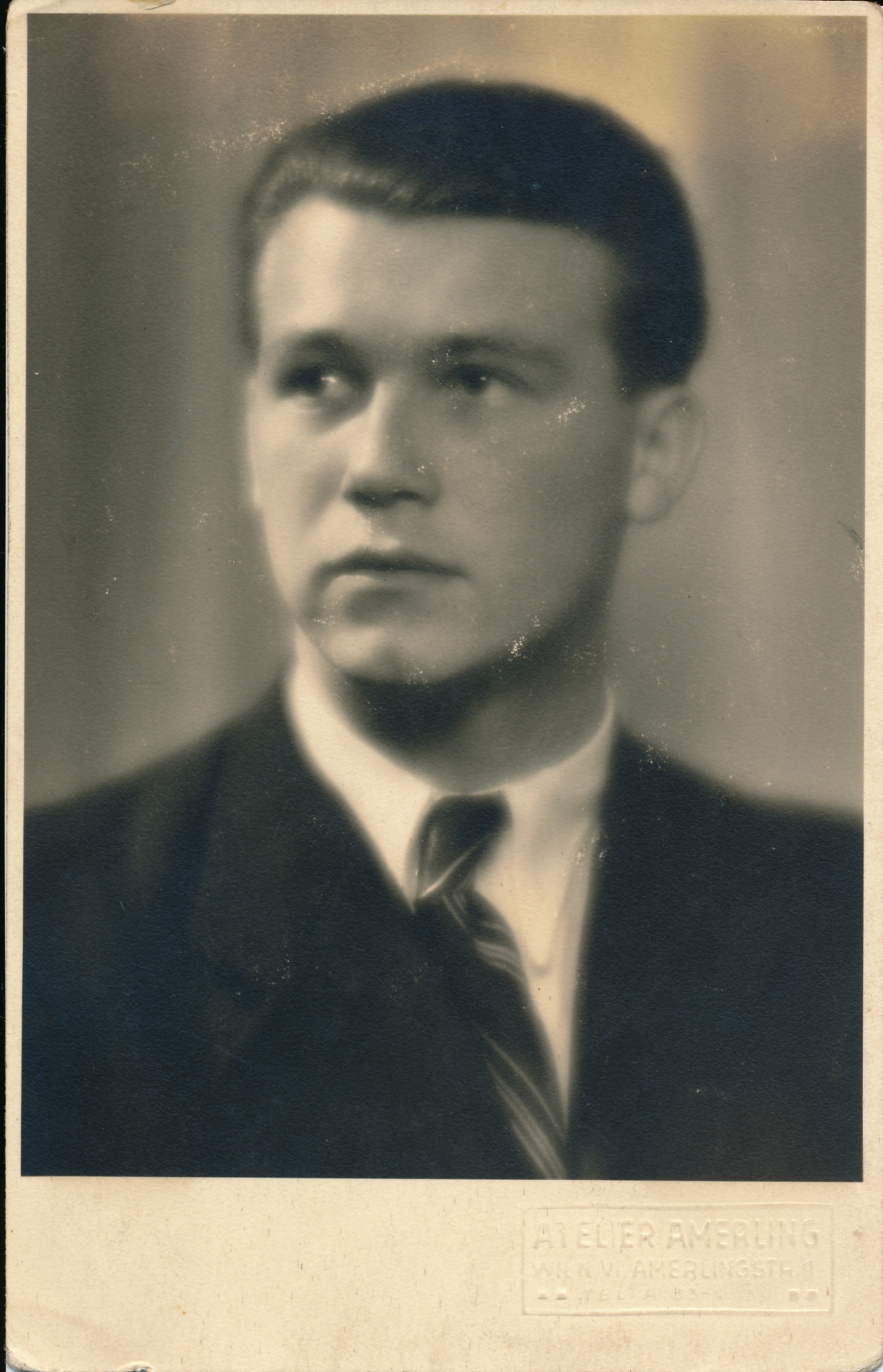
Richard Wadani, 1938.
Quelle: Privat Privatarchiv Richard Wadani
Richard Wadani was raised in Prague by his Austrian parents. Already in his youth he began sympathizing with the communists, and he joined their youth organization in the mid-1930s. As a result of the »Munich Agreement«, the family had to leave Czechoslovakia in 1938 and move to »Ostmark«, as Austria was called when it became part of Nazi Germany. Richard Wadani enlisted in the Wehrmacht in 1939 and served as an occupation soldier in the Soviet Union between 1941 and 1944. During this time, he supported partisan groups and thereby put up resistance to the Nazi regime. In October 1944, he defected to American troops on the Western front. He volunteered for the Czech exile army and returned to Vienna in December 1945, where he soon joined the Austrian Communist Party. Until retirement he worked, amongst other things, as a certified physical education teacher and coach of the Austrian national volleyball team. He left the Communist Party following the violent suppression of the »Prague Spring« in 1968. Since the late 1990s, he has provided the victims of Nazi military justice with a voice and a face. In 2009, the National Assembly acknowledged soldiers and civilians who had been persecuted by German military justice as victims of National Socialism. The »Repeal and Rehabilitation Act«, in which deserters and other victims of Nazi military justice were legally recognized as such, as well as the establishment of the memorial on Vienna’s Ballhausplatz can be attributed in part to his remarkable political commitment.
Literature
Koch, Magnus, Rettl, Lisa: Richard Wadani – Eine politische Biografie, »…und da habe ich gesprochen als Deserteur.«, Milena Verlag, Wien 2015.
»… he mostly kept to himself and showed little connection to his comrades.«
Erwin Kohout (1909-?)
On February 7, 1942, a Wehrmacht patrol arrested tailor apprentice Erwin Kohout, who had been born in 1909 in Linz, in his mother’s apartment. He explained that he had no longer felt comfortable with his unit in Ukraine, which is why he had deserted. He had, for example, quarreled with his superior. Although Kohout had abandoned his unit for close to three months, and thus permanently, the military court did not mete out a death sentence, as was the usual practice in such cases. The court gave him credit for the fact that he had not gone into hiding and had not committed crimes while away from his unit. Kohout was deported to the Emsland Camps in the northwest of the »Greater German Reich«, where he was to carry out hard forced labor for ten years. It is not known whether he survived the war.
»If only every decent Christian would save even one single Jew…«
Anton Schmid (1900–1941)
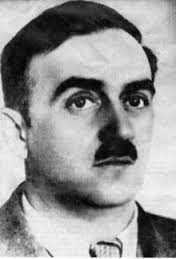
Anton Schmid, undatiert. Quelle: wikipedia.org
In March 1938, Anton Schmid and his wife Stefanie ran a radio shop in Vienna’s Klosterneuburgerstraße. Not long after Austria’s »Anschluss« to Germany in March 1938, he had helped Jewish friends escape National Socialist persecution. Since 1941, he was stationed in Lithuania as an occupation soldier. Immediately after the German invasion, the SS had begun carrying out brutal killing operations directed mostly against the Jewish population. They were supported by the Wehrmacht, police units, and Lithuanian auxiliary troops. Sergeant Anton Schmid was a witness to these crimes and he decided to help the victims. According to eyewitness accounts, he hid a young Jewish woman, Luisa Emaitisaite, and several other people at his duty station and supplied them with new documents. He also supported the Jewish resistance movement in Lithuania by helping some 300 Jewish men and women escape from the ghetto in Vilnius. Schmid was most probably denounced by two comrades in January 1942. A Wehrmacht court sentenced him to death shortly afterwards. He was shot in Vilnius on April 13, 1942. In 1966, the Israeli memorial Yad Vashem awarded Anton Schmid the honorary title of »Righteous Among the Nations«.
Literature
Wette, Wolfram: Feldwebel Anton Schmid. Ein Held der Humanität, Frankfurt a.M. 2013.
»…that louse Hitler.«
Franz Severa (1912-1944)
The mechanic Franz Severa, who was born in Vienna and raised in a social democratic environment, was a member of the »Socialist Protection League« when he was arrested by the Austro-fascist regime for several weeks in February 1934. In early 1941 – Severa was by then working in an airplane engine factory in Vienna’s Stammersdorf district – a colleague of his filed a complaint against him. Severa had allegedly called Adolf Hitler a »louse«. The presiding judge found that the defendant had »out of base motives deeply insulted« the commander-in-chief of the Wehrmacht and Reich chancellor and thereby tried to »undermine the nation’s trust in the political leadership«. After the Gestapo found Marxist literature while searching Severa’s apartment and he was once again denounced for anti-Nazi statements while at the Wehrmacht remand prison X in Vienna-Favoriten, the Division No. 177 court sentenced him to six years and six months in prison. Towards the end of the war, Severa was transferred to punitive battalion 999. He died on the Western front on December 28, 1944.
»Ten more comrades will die with me …«
Johann Lukaschitz (1919-1944)

Johann Lukaschitz, undatiert. Quelle: Gedenkstätte ROTER OCHSE Halle (Saale)
In January 1944, the Reich court martial sentenced Johann Lukaschitz, an advertising artist who had been born in Vienna in 1919, to death for »failing to report military treason«. Frustrated with the military situation in the fourth year of war and the harsh treatment by commanding officers, his comrades had established a »soldier’s council«. The Reich court martial considered this a conspiracy against Germany, drawing a connection to the situation at the end of World War I, when revolutionary workers’ and soldiers’ councils instigated an uprising in November 1918. The court martial ignored the fact that substantial amounts of alcohol had come into play during meetings of the »soldier’s council« and that the soldiers had not carefully planned their actions, as would be the case for political organizations. Evidently the case was to constitute a cautionary example. As a former member of the socialist youth movement »The Falcons«, Johann Lukaschitz was sympathetic towards the »schemers«. He paid with his life for not denouncing them. On February 11, 1944, he was executed by guillotine in the Halle/Saale prison.
Literature
Baumann, Ulrich; Koch, Magnus (Hg.): »’Was damals Recht war… Soldaten und Zivilisten vor den Gerichten der Wehrmacht’. Begleitband zur Wanderausstellung der Stiftung Denkmal für die ermordeten Juden Europas«, Berlin 2008.
Vogel, Detlef; Wette, Wolfram (Hg.): Das letzte Tabu. NS-Militärjustiz und Kriegsverrat, Berlin 2007.
»…I didn’t find the courage to voluntarily return to my unit.«
Anton Tischler (1912-1942)
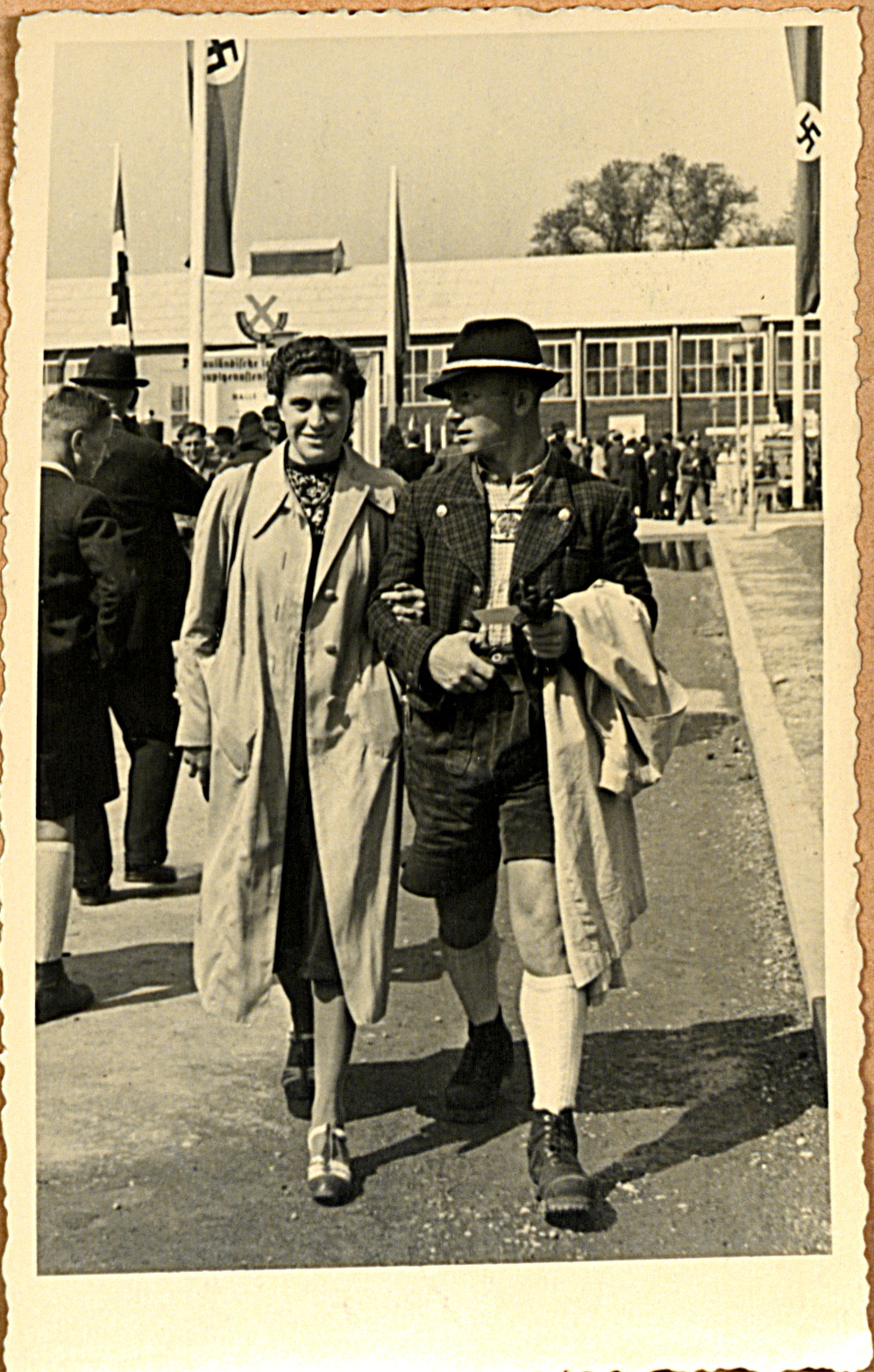
Anton und Margarete Tischler, undatiert.
Quelle: Österreichisches Staatsarchiv/Archiv der Republik
Anton Tischler had enlisted in the Wehrmacht in April 1940 and was at first stationed in occupied France. In August of that year, his sister-in-law asked him to come home, as his wife Margarete (née Reiter) had fallen ill and needed his help. In reality, she wanted for nothing; she was simply afraid of losing her husband in the upcoming battles of World War II. Tischler didn’t return to his unit from the special leave he had been granted and managed to keep his support for his family a secret for nearly a year. He was most probably denounced by neighbors and arrested by military police in October 1941. He was able to avoid a death sentence only because his wife had repeatedly pleaded with him to stay with her. Margarete Tischler was comparatively harshly punished, receiving a 3-year prison sentence. Anton Tischler did not survive the war. He was deployed to a forced labor unit from the infamous Emsland camps in the northwest of the German Reich to the so-called »northern camps« in northern Scandinavia. Anton Tischler died there of the grueling conditions of imprisonment on November 2, 1942. He left behind his wife and their two children.
»…because otherwise she would have been sent to a concentration camp«
Erich Schiller (*1923)
In the winter of 1942, signalman Erich Feucht, who had been born in Lower Austrian Weitra, met Margit Stahl from Hungary in Berlin. She was afraid of being deported to a concentration camp, since according to the Nuremberg race laws she was considered a Jewish »Mischling«, so she asked him to help her. A few months later, Feucht helped her cross the border, after which he returned to Vienna and waited for a message from Budapest. When he did not hear from Margit Stahl, he set off for Budapest to make sure his acquaintance had arrived safely. Hungarian police arrested the 21-year-old and detained him for several months. The authorities eventually believed his story and he was granted a residence permit and a work permit. Feucht was arrested by a Wehrmacht patrol in Hungary just before Christmas 1943. The country had been Germany’s ally since 1941. The Division 177 court believed that Erich Feucht had acted out of compassion and sentenced him to 12 years in prison. He was deported to an Emsland camp and most probably survived the war.
»…humble and quiet, but unwavering in his beliefs«
Ernst Volkmann (1902-1941)

Ernst Volkmann, um 1930.
Quelle: Stadtarchiv Bregenz
Ernst Volkmann had to die because he refused to fight for Nazi Germany on religious grounds. The deeply religious guitar maker, born in 1902 in Bohemian Schönbach (today Luby in Czechia), strongly resented National Socialism from its early days. In the 1920s, he moved to Vorarlberg and established himself there professionally. In 1929, he married Maria Handle from Bregenz, with whom he had three children. He ignored all Wehrmacht conscription orders, which is why Ernst Volkmann was arrested in June 1940. In 1941, the Reich court martial in Berlin took over his case.
Conscientious objection was considered a political crime. He stood by his religious beliefs until the end, seeing military service as a »violation of his moral freedom to defend himself against National Socialism«, for which the Berlin court sentenced him to death on July 7, 1941. A month later on August 9, at 5:05 am, Ernst Volkmann was beheaded in the Brandenburg-Görden prison. Until today, his name is engraved on the Bregenz war memorial honoring those killed in action during the world wars. From 1958, his fate was indicated at the church opposite the memorial; in 2010, a commemorative stele was dedicated to Ernst Volkmann in the vicinity of the war memorial.
Literature
Meinrad Pichler: »Nicht für Hitler«. Der katholische Kriegsdienstverweigerer Ernst Volkmann (1902–1941). In: Emerich, Susanne; Buder, Walter (Hg.): Mahnwache Ernst Volkmann (1902–1941). Widerstand und Verfolgung 1938–1945 in Bregenz, Feldkirch 2005, S. 6–11.
»…I left my unit and thought that I’d like to go home«
Johann Kuso (1923-1990)
In April 1943, Johann Kuso, an airplane mechanic from Steinbrunn in Burgenland, left his unit, which at the time was stationed at a military training area in Slovakia. He was captured a mere two days later, and during his interrogation he said that he had fled out of fear of punishment for a guard duty misdemeanor. Moreover, Kuso did not get along with the »comrades« in his unit. According to the military penal code, an absence of up to three days was considered an »absence without leave«, which usually resulted in shorter prison sentences. Yet Vienna’s Division 177 court classsified Johann Kusos’ absence as desertion, meaning a deliberate and permanent absence. His brief training and the short period of absence were considered mitigating circumstances. Nevertheless, a prison sentence entailed removing the convict from the Wehrmacht and handing him over to the civil judiciary. Internment usually took place at the infamous Emsland camps in the northwest of the »Greater German Reich«, where prisoners had to carry out hard forced labor in conditions reminiscent of a concentration camp. Unlike many of his fellow prisoners, Johann Kuso survived. He returned to his hometown and ran a tobacco kiosk. Johann Kuso later moved to Vienna, where he died on March 13, 1990.
»Now this is just stupid…«
Anton Brandhuber (1914-2008)
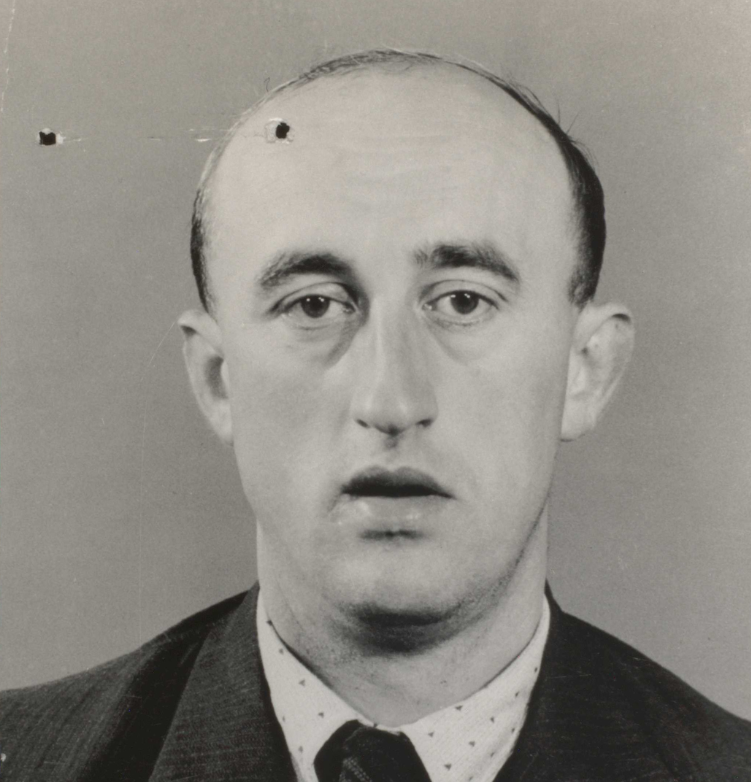
Anton Brandhuber, 1942.
Quelle: Schweizerisches Bundesarchiv, Bern
Anton Brandhuber, a farmer from Laa an der Thayer in Lower Austria, deserted from the Soviet front in February 1942. The 45th infantry division, which had been formed in Austria, had suffered severe losses outside of Moscow and was to be replenished with new soldiers from home. Brandhuber left his unit before it had reached its furthest position. His 10-day flight took him all across Europa to Feldkirch on the border between Austria and Lichtenstein. On February 27 he managed to get past the heavily secured fence system across the border to Switzerland. During questioning he stated for the record that the conditions upon arrival in Orjol – extreme cold, insufficient provisions and a bleak spirit among the soldiers – had been the immediate cause of his flight. The Swiss officer interrogating him wrote of his motives: »The interviewee claims that hopelessness for the future as well as the compulsion to fight for a regime he as an Austrian loathes are the main reason for his flight.« After the end of World War II, Anton Brandhuber returned to Austria. He lived on his farm in Laa an der Thaya until his death on August 28, 2005.
Literature
Hamburger Institut für Sozialforschung (Hg.): Verbrechen der Wehrmacht – Dimensionen des Vernichtungskrieges 1941 – 1944. Ausstellungskatalog, Hamburg 2002.
Koch, Magnus: Fahnenfluchten. Deserteure der Wehrmacht im Zweiten Weltkrieg, Krieg in der Geschichte, Bd. 42, Paderborn 2008.
»So they said they wanted to have their arms broken«
Maria Musial (1919-2012)
The hairdresser Maria Lauterbach was born in 1919 to a working-class family of ten in Simmering. In the 1930s, the Musial family was active in the communist resistance movement: at first against the Austro-fascist regime, then against the National Socialists after 1938. In 1942, Maria married the trained machine fitter and officer of the Luftwaffe (German air force) Ernst Musial. Together they helped soldiers who did not want to fight to evade serving in the Wehrmacht – by deliberately inflicting bone fractures. Maria procured the necessary anesthetics from a doctor she knew. News of a conspicuous increase in cases of broken arms reached Karl Everts, chief judge in Vienna’s Division 177, at the turn of 1943/1944. He used an informer and eventually arrested the entire network in the summer of 1944. Maria’s nephew Karl Lauterbach and 13 other members of the Viennese »self-mutilation network« were executed for »undermining the military forces«; Maria Musial was sentenced to six years in prison, her husband to 12 years. Both survived to see the end of the war, though Ernst Musial was soon unable to work due to the long-term effects of his time in prison. Maria took care of him and had to give up working as a hairdresser. She remained politically active and was one of a group of survivors of Nazi military justice whom the committee »Justice for victims of Nazi military justice« invited to an annual commemoration in Kagran’s Donaupark from 2002 on. Maria Musial died in 2005.
Literature
»I always feel that I am a human first, then a Pole«
Krystyna Wituska (1920-1944) und Maria Kacprzyk (1922-2011)
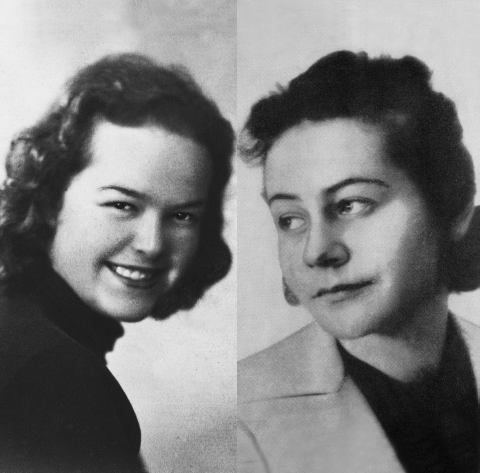
Maria Kacprzyk und Maria Wituska, um 1940.
Quellen: Privatarchiv Maria Kacprzyk, Danzig sowie Universytecka w Warszawie
On September 1, 1939, the German Wehrmacht invaded Poland. For the Polish population, daily life was characterized by raids, arrests and executions. Many were deported as forced laborers to serve the German wartime economy. Krystyna Wituska, the daughter of an estate owner, and Maria Kacprzyk, who came from a family of entrepreneurs, decided to put up resistance to the oppression. They were given the task of gathering information about the occupation forces. When their resistance network was uncovered, the young women were arrested in October 1942 and transferred to Berlin. On April 19, 1943, Werner Lueben, senate president at the Reich court martial, sentenced Krystyna Wituska to death for espionage, preparations for treason and aiding the enemy. Her friend Maria was sentenced to eight years in a harsh penal camp. She survived the war, while Krystyna Wituska was executed by guillotine on June 26, 1944 at the behest of the Reich court martial. After 1945, Maria had a hard time coming to terms with the loss of her friend and suffered of depression for a long time. She studied medicine, went to acting school, worked as a tour guide, got married and had two children. In the 1980s, Maria Kacprzyk was active in the Solidarność movement, which sought Poland’s democratization and its disengagement from the Warsaw Pact. She died on April 4, 2011 in Gdańsk.
Literature
Skowronski, Lars; Trieder, Simone: Zelle Nr. 18. Eine Geschichte von Mut und Freundschaft, Berlin 2014.
»…because the others pestered me too much«
Alois Tiefengruber (1912-?)
When Alois Tiefengruber, who had been born in Graz, had to join the Wehrmacht in September 1942, he could hardly look back on a well-adjusted life: he had never met his father and had lived with foster parents already before the untimely death of his mother. Problems at school were followed by health constraints. Since the age of seven, Tiefengruber had suffered epileptic fits, which led to psychiatric examinations and hospital stays. He became addicted to alcohol. In the army, he quickly became a source of irritation in his unit, as he wouldn’t or couldn’t deal with the military drill. He left his unit after only a few days, stating that he had been excluded and tortured by his »comrades«. On his 30th birthday he was initially sentenced to ten years in prison for desertion and »recidivist theft«. Since the sentence was not confirmed by the Army High Command, the court tried the case anew; despite the prosecution’s demands, there was no death sentence, probably because of Tiefengruber’s health issues. Such leniency was rare in similar cases before Wehrmacht courts. Tiefengruber was sent to a field penal camp – the harshest form of imprisonment within the Wehrmacht – and it is not known whether he survived.
Literature
Baumann, Ulrich; Koch, Magnus (Hg.): »’Was damals Recht war… Soldaten und Zivilisten vor den Gerichten der Wehrmacht’. Begleitband zur Wanderausstellung der Stiftung Denkmal für die ermordeten Juden Europas«, Berlin 2008.
Baumann, Ulrich: »Wo sind die Deserteure?« Öffentliche Meinung und Debatten über Verurteilte der Wehrmachtjustiz in der Bundesrepublik Deutschland 1949-1998. In: Pirker, Peter; Wenninger, Florian (Hg.): Wehrmachtsjustiz. Kontext, Praxis, Nachwirkungen, Wien 2010, S. 270-285.
Forster, David: Die militärgerichtliche Verfolgung von Verratsdelikten im Dritten Reich. In Manoschek, Walter (Hg.): Opfer der NS-Militärjustiz. Urteilspraxis – Strafvollzug – Entschädigungspolitik in Österreich, Wien 2003, S. 238-253.
Fritsche, Maria: Entziehungen. Österreichische Deserteure und Selbstverstümmler in der Deutschen Wehrmacht, Wien 2004.
Fritsche, Maria: Feige Männer? Fremd- und Selbstbilder von Wehrmachtsdeserteuren. In: Ariadne 47 (2005), ‘Kriegsfrauen und Kriegsmänner’. Geschlechterrollen im Krieg, S. 54-61.
Fritsche, Maria: Österreichische Opfer der NS-Militärgerichtsbarkeit. Grundlegende Ausführungen zu den Untersuchungsergebnissen. In: Manoschek, Walter (Hg.): Opfer der NS-Militärjustiz. Urteilspraxis – Strafvollzug – Entschädigungspolitik in Österreich, Wien 2003, S. 80-103.
Fritsche, Maria: Die Verfolgung von österreichischen Selbstverstümmelern in der deutschen Wehrmacht. In: Manoschek, Walter (Hg.): Opfer der NS-Militärjustiz. Urteilspraxis – Strafvollzug – Entschädigungspolitik in Österreich, Wien 2003, S. 195-214.
Fritsche, Maria: »Goebbels ist der größte Depp«. Wehrkraftersetzende Äußerungen in der deutschen Wehrmacht. In: Manoschek, Walter (Hg.): Opfer der NS-Militärjustiz. Urteilspraxis – Strafvollzug – Entschädigungspolitik in Österreich, Wien 2003, S. 215-237.
Geldmacher, Thomas u.a. (Hg.): »Da machen wir nicht mehr mit«. Österreichische Soldaten und Zivilisten vor Gerichten der Wehrmacht, Wien 2010.
Geldmacher, Thomas: »Auf Nimmerwiedersehen!« Fahnenflucht, unerlaubte Entfernung und das Problem, die Tatbestände auseinanderzuhalten. In: Manoschek, Walter (Hg.): Opfer der NS-Militärjustiz. Urteilspraxis – Strafvollzug – Entschädigungspolitik in Österreich, Wien 2003, S. 133-194.
Haase, Norbert: Von »Ons Jongen«, »Malgré –nous« und anderen. Das Schicksal der ausländischen Zwangsrekrutierten im Zweiten Weltkrieg. In: Haase, Norbert; Paul, Gerhard (Hg.): Die anderen Soldaten. Wehrkraftzersetzung, Gehorsamsverweigerung und Fahnenflucht im Zweiten Weltkrieg, Frankfurt 1995, S. 157-173.
Koch, Magnus: Fahnenfluchten. Deserteure der Wehrmacht im Zweiten Weltkrieg, Krieg in der Geschichte, Bd. 42, Paderborn 2008.
Koch, Magnus: Prägung – Erfahrung – Situation. Überlegungen zur Frage, warum Wehrmachtssoldaten ihre Truppe verließen. In: Kirschner, Albrecht (Hg.): Deserteure, Wehrkraftzersetzer und ihre Richter. Marburger Zwischenbilanz zur NS-Militärjustiz vor und nach 1945, Marburg 2010, S. 149-162.
Reemtsma, Jan Philipp: Wie hätte ich mich verhalten? Gedanken über eine populäre Frage. In: Ders. »Wie hätte ich mich verhalten?« Und andere nicht nur deutsche Fragen, München 2001, S. 9-29.
Rothmaler, Christiane: »…weil ich Angst hatte, daß er erschossen würde«. Frauen und Deserteure. In: Ebbinghaus, Angelika; Linne, Karsten (Hg.): Kein abgeschlossenes Kapitel: Hamurg im »Dritten Reich«, Hamburg 1997, S. 461-486.
Walter, Thomas: Die Kriegsdienstverweigerer in den Mühlen der NS-Militärgerichtsbarkeit. In: Manoschek, Walter (Hg.): Opfer der NS-Militärjustiz. Urteilspraxis – Strafvollzug – Entschädigungspolitik in Österreich, Wien 2003, S. 114-132.
Weitere Sammlungen von Biografien von Verfolgten bieten folgende Instiutionen an:
Dokumentationsarchiv des österreichischen Widerstands
:::
The first Deserter’s Monument is situated in Vienna
On October 24, 2014, the Memorial to deserters and other victims of Nazi military justice was dedicated in a state ceremony on Ballhausplatz in the heart of Vienna.
Neu: Broschüre zum Deserteursdenkmal. Klick aufs Bild zum Anschauen & Download.
During the Second World War Nazi military justice handed out more than 30,000 death sentences: against soldiers, prisoners of war and civilians, in particular from the regions occupied by the German Wehrmacht all over Europe. Most of the death sentences were passed against deserters and “Wehrkraftzersetzer” (subverters of the war effort). Many thousands of other soldiers died at the front after being sentenced by the military courts to serve in “penal/probation battalions”.
The actions punished, ways of life and biographical backgrounds of those persecuted varied widely. Political opponents of Nazism faced the military courts just as much as people who were looking for individual freedom for very different reasons. Any form of resistance or, for example, support for deserters by civilian helpers was regarded as a political crime and was thus punished with the greatest severity.
After the end of the war, Austrian society met the survivors of this persecution with rejection and hostility. Because in Austria for a long time the myth continued that in 1938 it was made the “first victim” of German war policy; yet the service of Austrian soldiers in the Wehrmacht was considered to be the fulfillment of duty or even heroic.
Inspired by historic research, it was only after the turn of the century that the recognition prevailed that Nazi military justice had put itself unconditionally at the service of a criminal war. In 2009, with the votes of the Social Democrats, the People’s Party and the Green Party, Austria’s National Assembly rehabilitated the victims of the persecution by the Wehrmacht courts, and in 2010 the City of Vienna decided to erect a monument to the victims of Nazi military justice.
The Memorial
The sculpture by Olaf Nicolai on this central location of the Austrian Republic takes up the classical elements of a memorial, the “pedestal” and the “inscription”. Yet it arranges these completely differently than in traditional war memorials. An outsized, lying “X” constitutes the three-step pedestal, on the third level of which the inscription is embedded. The text is only readable from above and quotes a poem by the Scottish artist Ian Hamilton Finlay (1925–2006), who was friends with important representatives of the language-critical and experimental Viennese artists’ scene. The interplay between pedestal and inscription stages the situation of the individual in and toward the social order and power relations. Threatened by anonymization and extinction, which turn him into an “X” in a file, his or her position is nonetheless central. The sculpture demonstrates respect for all those who take their own decision, defy heteronomy and through their independent action position themselves against the prevailing system.
The Artist
Olaf Nicolai grew up in Karl-Marx-Stadt, what is today Chemnitz. Between 1983 and 1988 he pursued a degree in German studies and went on to earn his doctorate at the University Leipzig (entitled “Gestures between Expression and Calculation. On the Poetics of the Vienna Group”). Since the beginning of the 1990s, he has presented his works both in group and solo exhibitions at the most important locations of the contemporary art scene.
-
- Deserteursdenkmal, Ballhausplatz, Wien 2014 (Foto: Iris Ranzinger/KÖR)
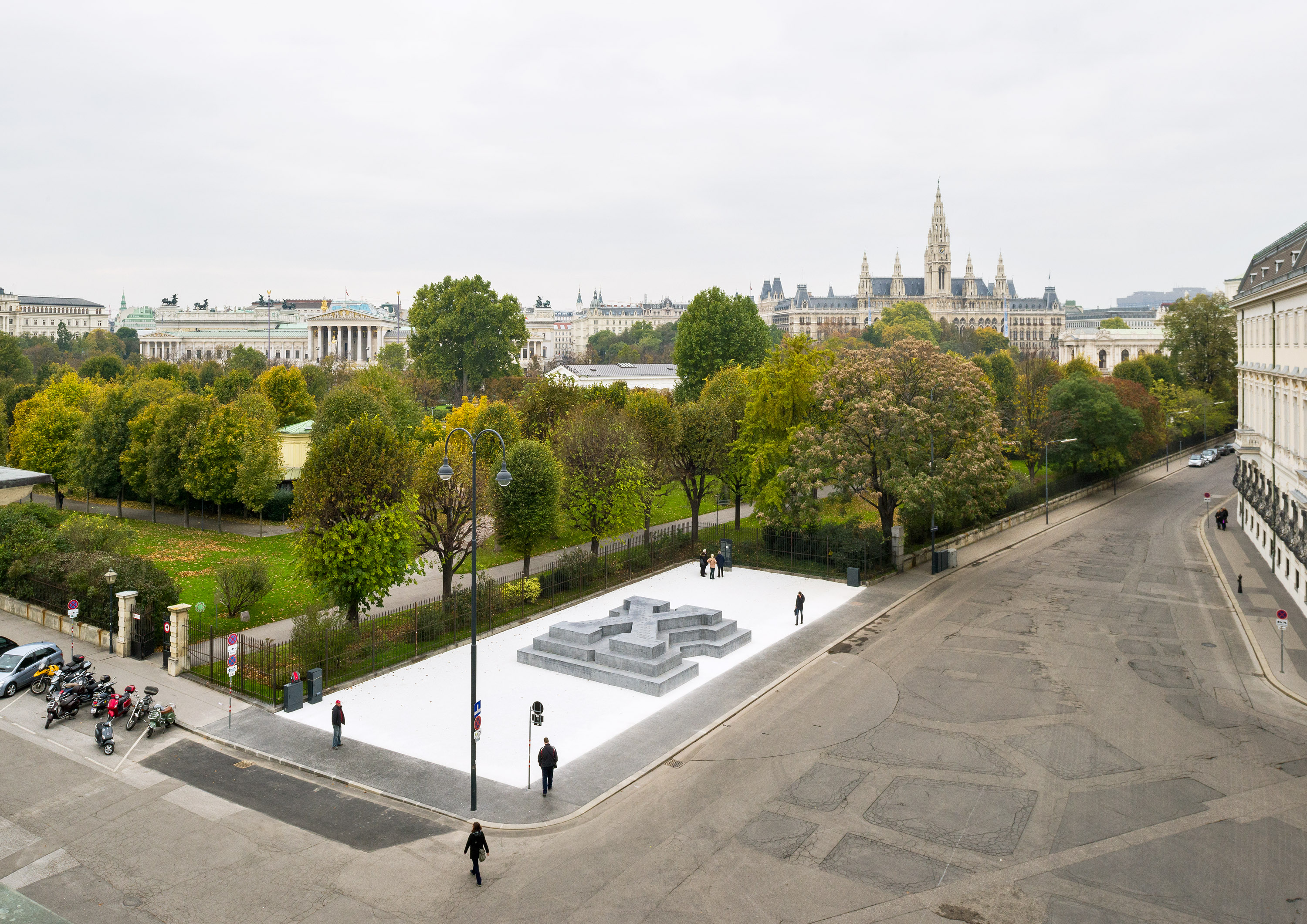
-
- Deserteursdenkmal, Ballhausplatz, Wien 2014 (Foto: Iris Ranzinger/KÖR)
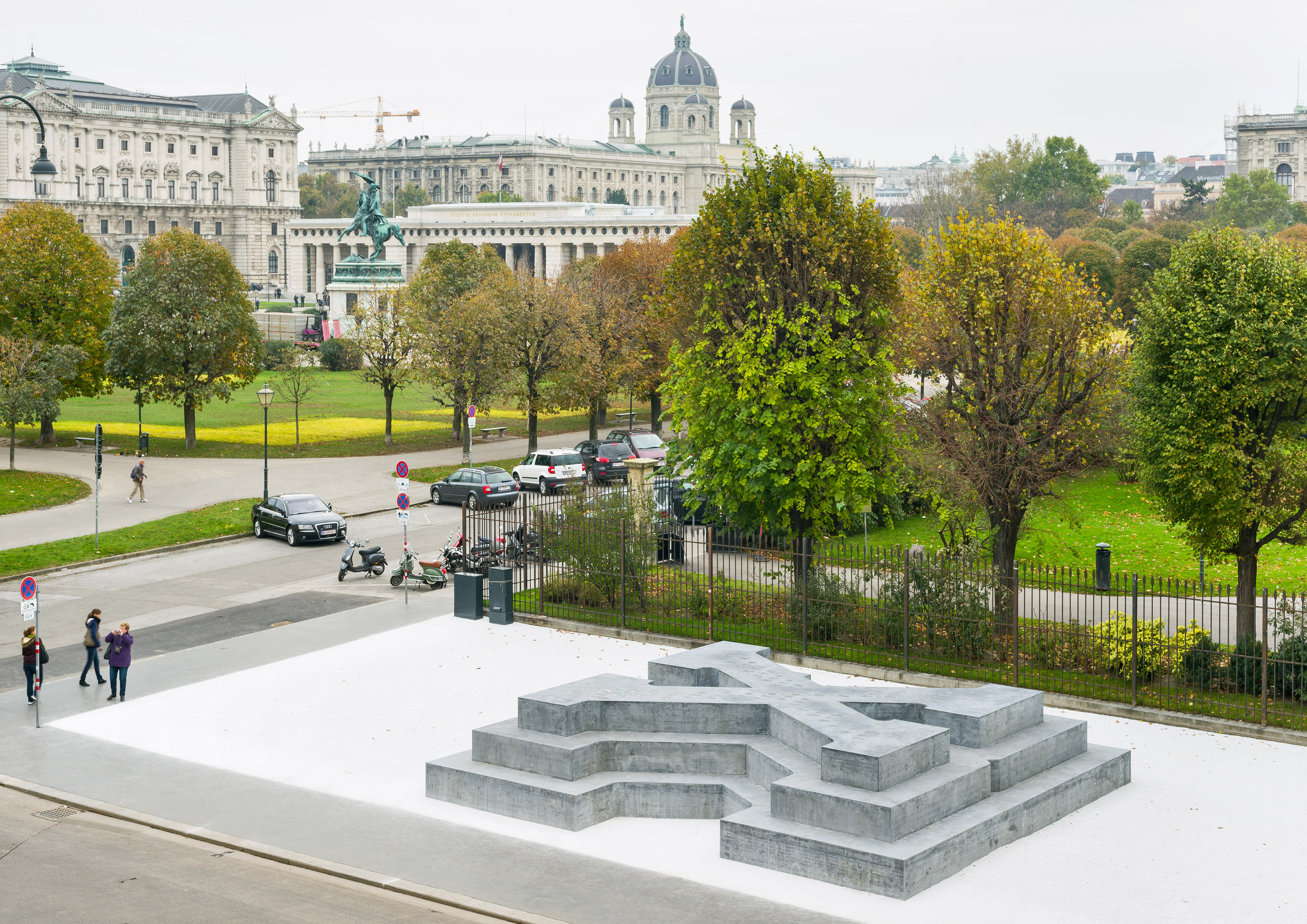
-
- Deserteursdenkmal, Ballhausplatz, Wien 2014 (Foto: Iris Ranzinger/KÖR)
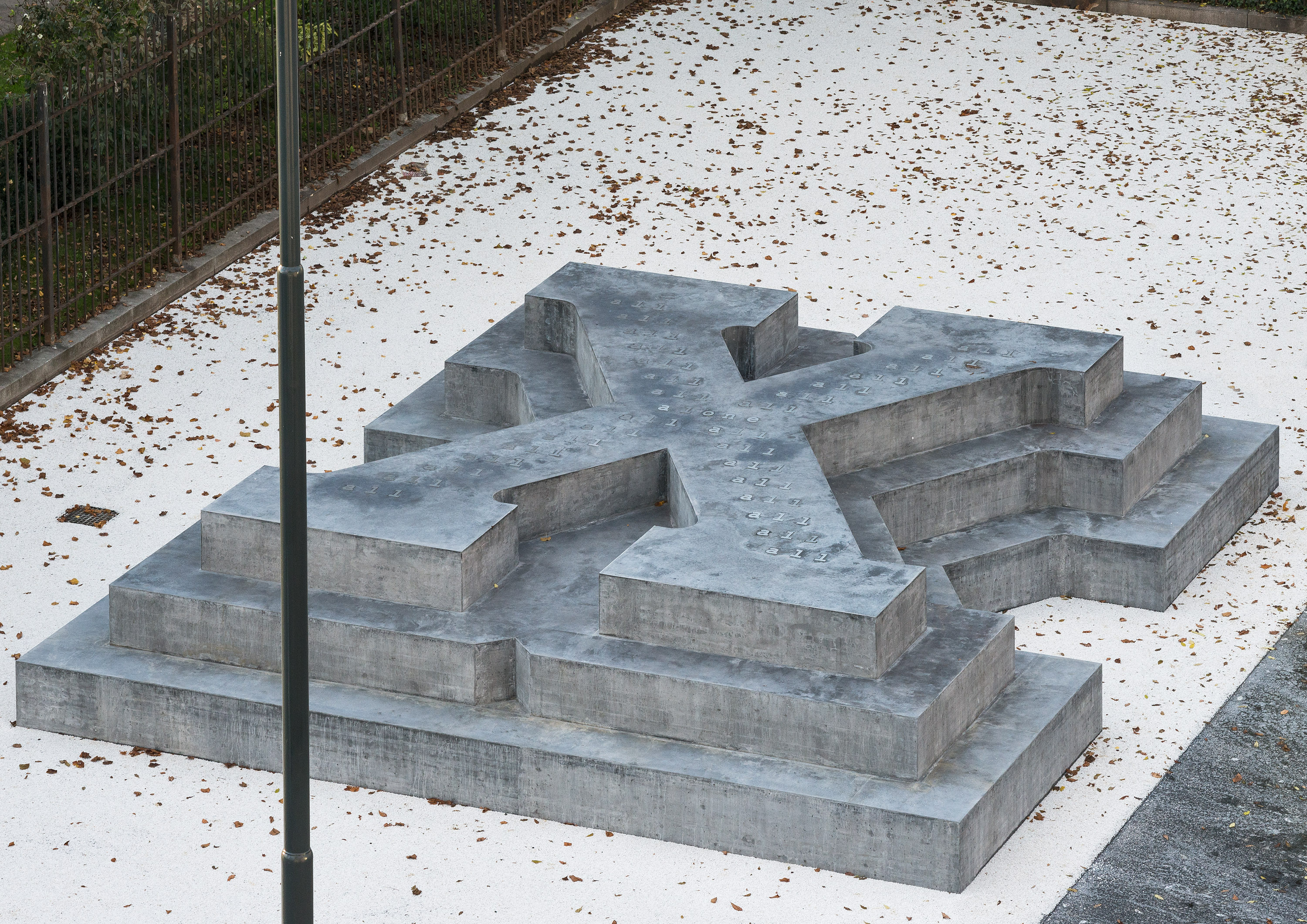
-
- Bundeskanzleramt und Deserteursdenkmal, Ballhausplatz, Wien 2014 (Foto: Iris Ranzinger/KÖR)
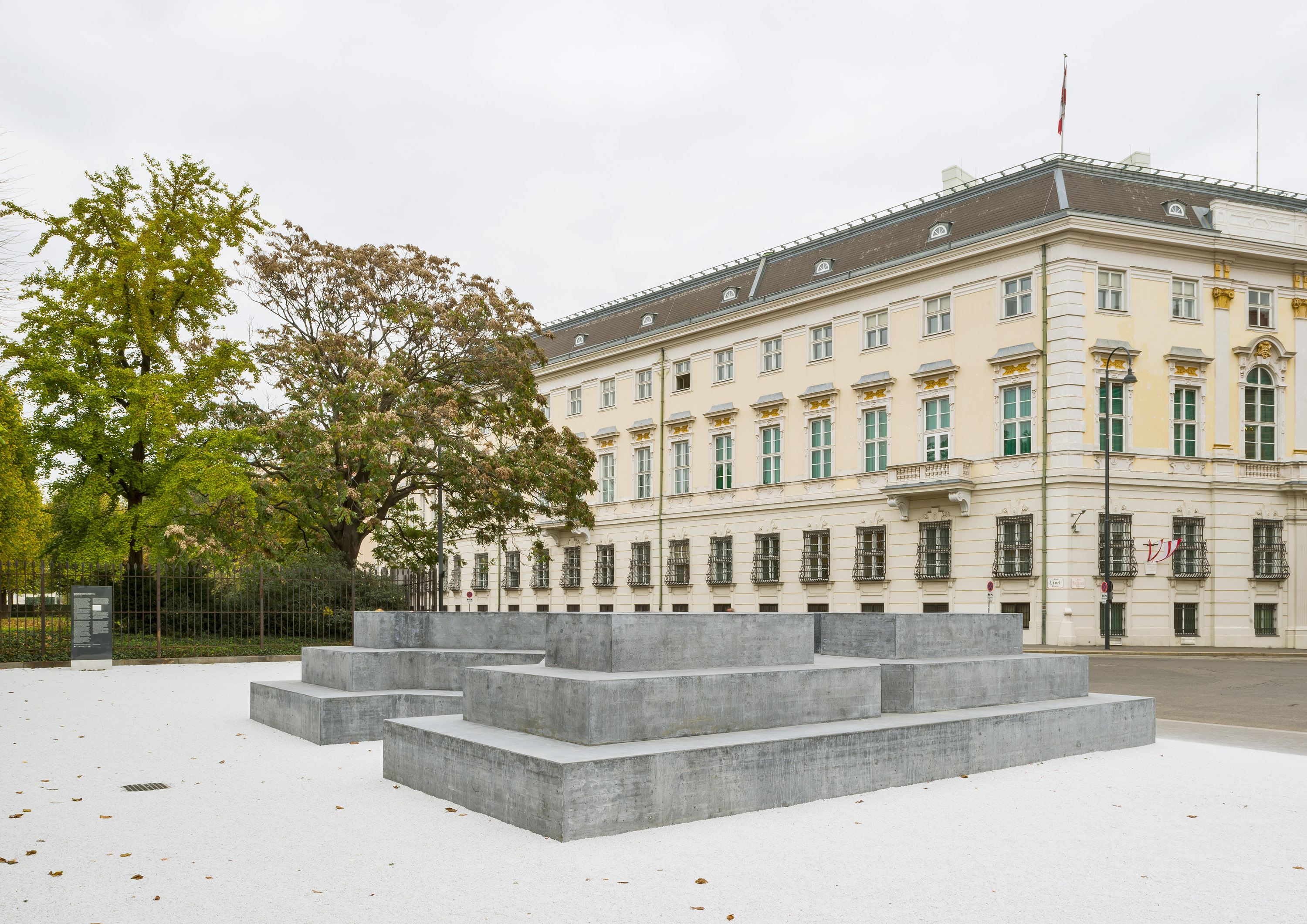
-
- Kanzlei des Bundespräsidenten und Deserteursdenkmal, Ballhausplatz, Wien 2014 (Foto: Iris Ranzinger/KÖR)
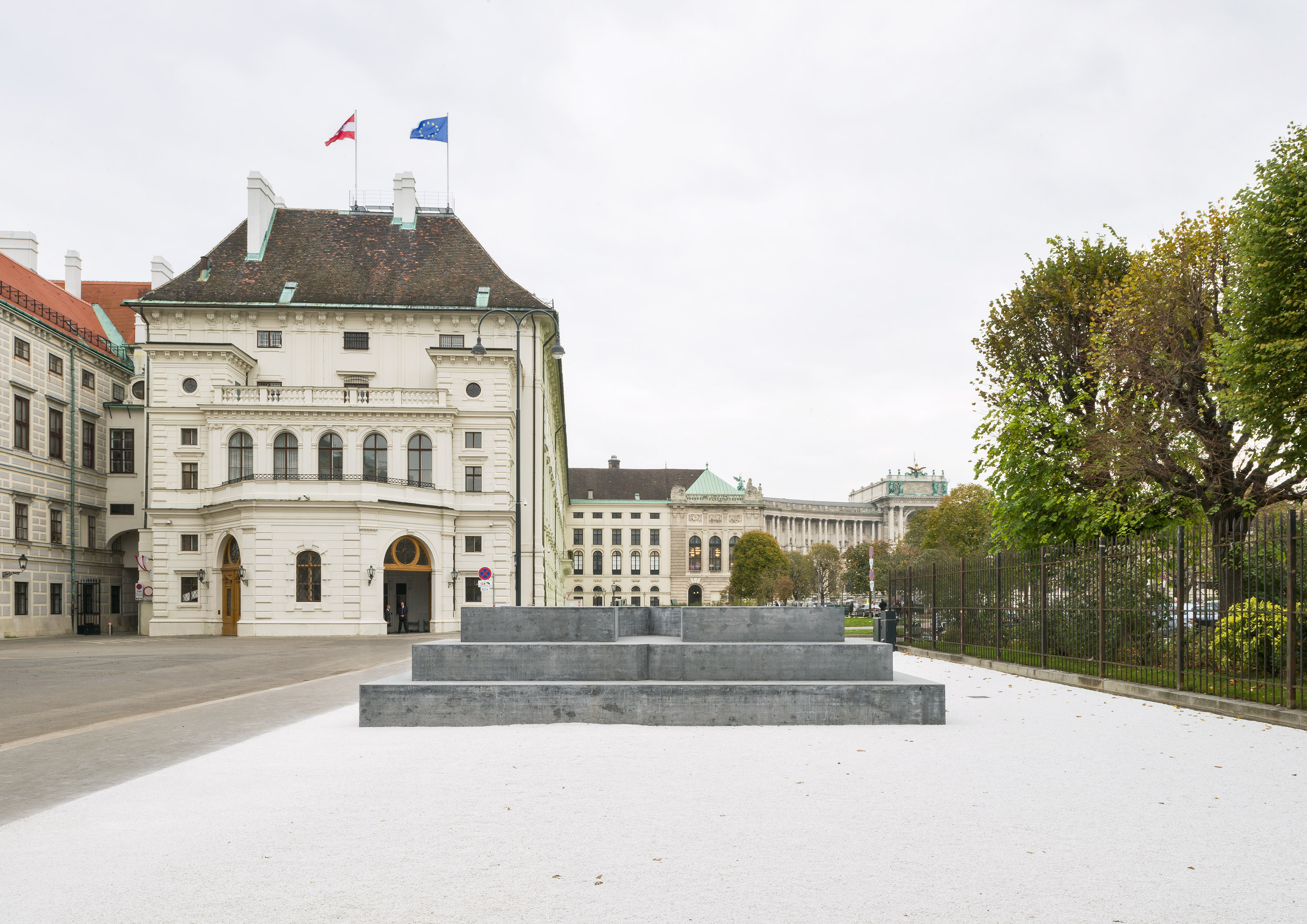
-
- Deserteursdenkmal, Ballhausplatz, Wien 2014 (Foto: Iris Ranzinger/KÖR)
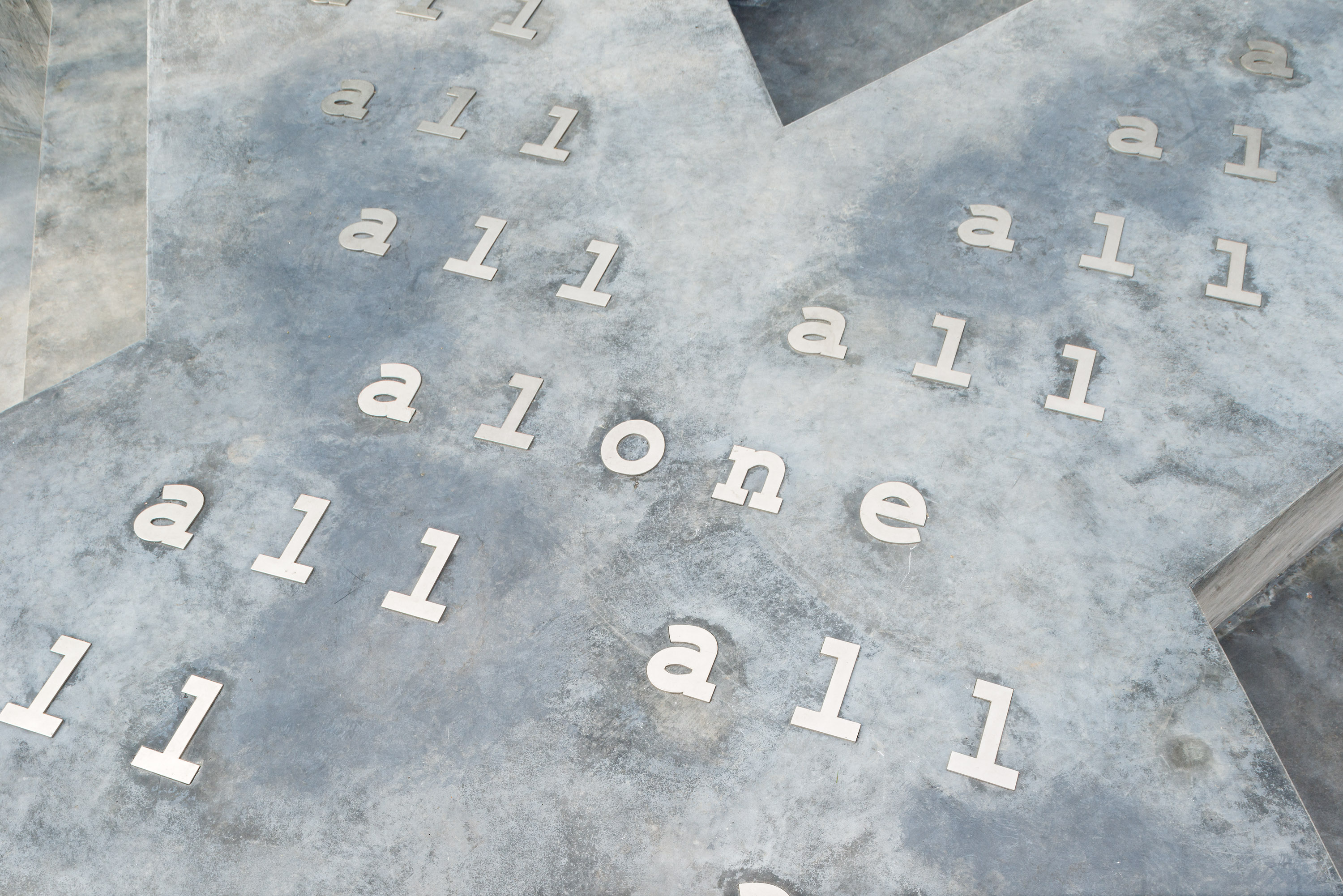
-
- Deserteursdenkmal, Ballhausplatz, Wien 2014 (Foto: Iris Ranzinger/KÖR)
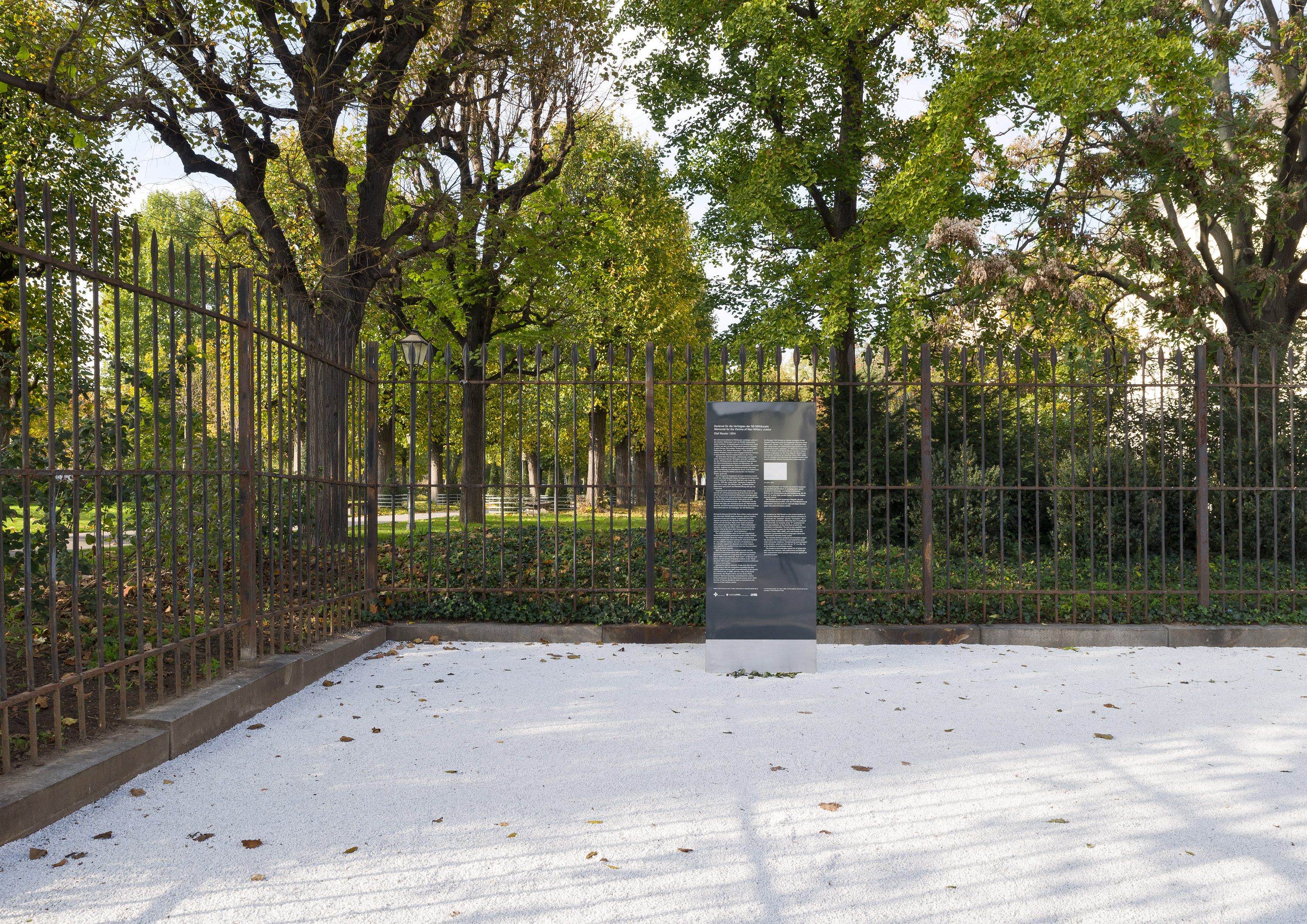
-
- Deserteursdenkmal, Ballhausplatz, Wien 2014 (Foto: Iris Ranzinger/KÖR)
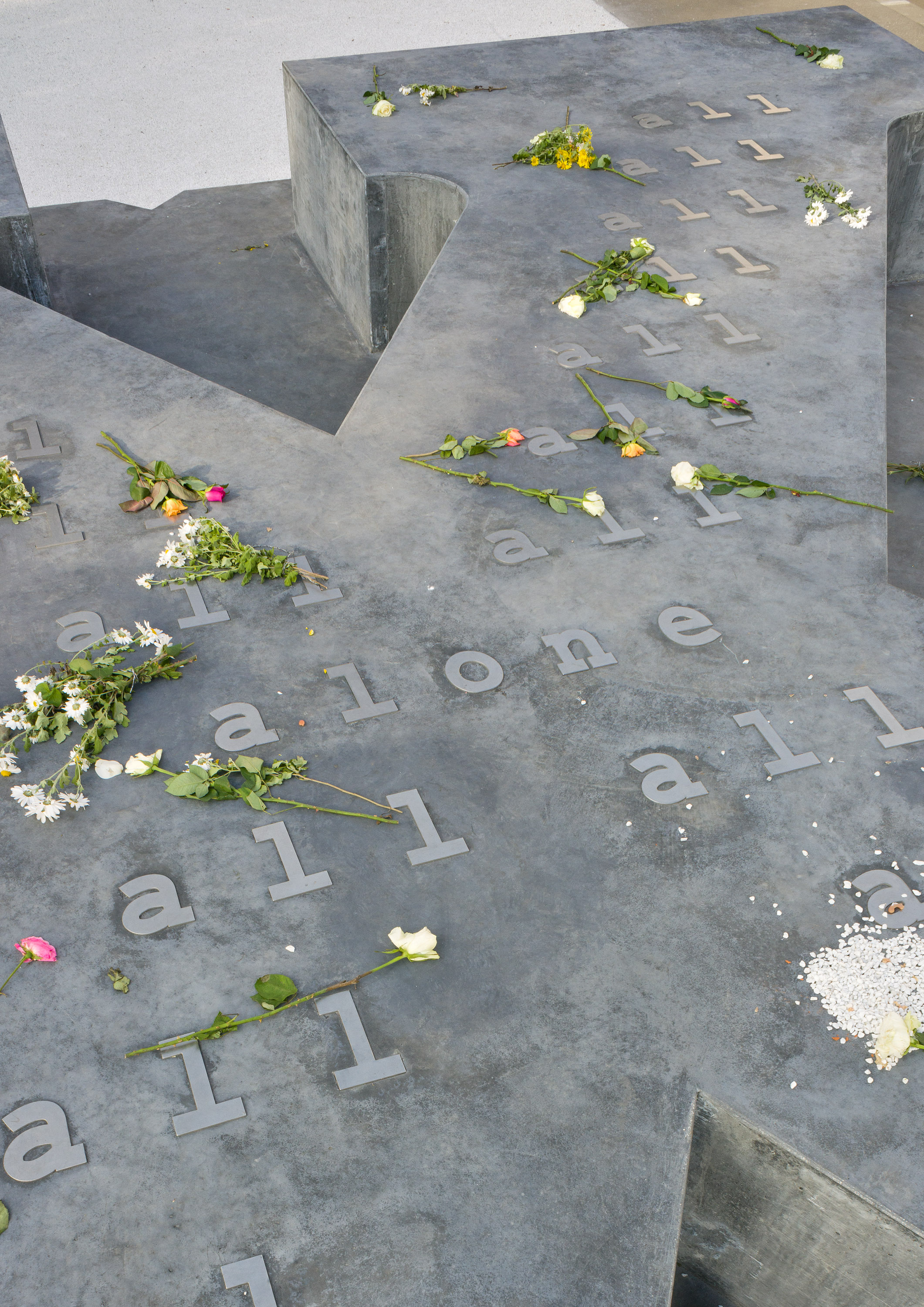




Education and Outreach
The Memorial to the Victims of Nazi Military Justice pertains to an issue that has until recently been hardly known to the Austrian public. First articles portraying victims and presenting historical facts appeared in the media in the 2000s in the course of the debate on the rehabilitation of deserters. Several scholarly books and articles were published after 2009.
Yet school books and adult education programs still lack any reference to Wehrmacht jurisdiction in the German Reich. This is why extensive materials were developed in 2015 and 2016 to convey the history of the persecutions of disobedient soldiers and members of European resistance movements by the military judiciary as well as its consequences.
The Federal Ministry of Education and erinnern.at distribute these materials to Austrian schools and various multipliers. The materials, which can be downloaded here, are meant for a broad audience: relatives and descendants of victims, tourists and people partaking in educational tours, students and all those interested in history and politics.
The development of educational materials for the Memorial at Ballhausplatz were supported by
- The National Fund of the Republic of Austria for Victims of National Socialism,
- The Culture Department of the City of Vienna (MA 7/Funding of Academia and Research, Stipends),
- The Future Fund of the Republic of Austria,
- The Federal Ministry of Education.
Vermittlung
Das Denkmal für die Verfolgten der NS-Militärjustiz steht für ein Thema, das in der österreichischen Öffentlichkeit bisher kaum präsent ist. Zwar fanden sich insbesondere im Zuge der Diskussionen um die Rehabilitierung der Deserteure in den 2000er Jahren erstmals Beiträge über Zeitzeugen und historische Details zur Verfolgung in den Medien; und insbesondere seit 2009 wurden einige fachwissenschaftliche Bücher und Aufsätze veröffentlicht.
In Schulbüchern oder auf dem Feld der Erwachsenenbildung sucht man Informationen zur „Großdeutschen“ Wehrmachtsgerichtsbarkeit allerdings nach wie vor vergeblich. Deshalb wurden in den Jahren 2015 und 2016 vielfältige Materialien zur Vermittlung der Geschichte militärgerichtlicher Verfolgungen von ungehorsamen Soldaten und Angehörigen europäischer Widerstandsbewegungen sowie zu deren Nachgeschichte erarbeitet.
Das Bundesministerium für Bildung und Frauen sowie erinnern.at sorgen für die Verbreitung in österreichischen Schulen sowie an verschiedene MultiplikatorInnen. Diese hier auch als Download zur Verfügung gestellten Materialien sind für alle gedacht: für Angehörige und Nachfahren der Verfolgten, für TouristInnen und Bildungsreisende, für Studierende und allgemein für historisch und politisch Interessierte.
Die Maßnahmen für die Vermittlungsarbeit rund um das Denkmal am Ballhausplatz wurden unterstützt aus folgenden Mitteln:
- des Nationalfonds der Republik Österreichs für Opfer des Nationalsozialismus,
- der Kulturabteilung der Stadt Wien (MA 7/ Wissenschafts- und Forschungsförderung, Stipendien),
- des Zukunftsfonds der Republik Österreich und
- des Bundesministeriums für Bildung und Frauen.
Sites of Persecution
Sites of Imprisonment: WUG II | WUG VII | WUG X | WUG XIX | WUG XXI | Rossauer Lände |
Sites of Military Courts: Hohenstaufengasse | Schwindgasse | Loquaiplatz | Otto-Wagner-Platz | Maxingstraße | Universitätsstraße | Franz-Josefs-Kai | Stubenring |
Sites of Military Police: Rossauer Kaserne | Franz-Josefs-Kai | Kohlmarkt |
Executions Sites: Shooting Range Kagran | Landesgericht |
Vienna was one of the centers of Nazi military justice in the Third Reich. Numerous organs of persecution were located here, in military district XVII: military courts, interrogation and torture sites, prisons and execution sites. Almost nobody knows today where they were situated and what happened at these places. The commemoration sites lie hidden within the city; such topographical knowledge yet is central for an appropriate remembrance.
Citymap of Persecution
For enlarged display and detailed descriptions of 16 sites in Vienna please click on the blue pins. You can move the map with the cursor.
If any problem arrise, please press F5!

Literaturhinweis
Lichtenwagner, Mathias: Leerstellen. Zur Topografie der Wehrmachtjustiz in Wien vor und nach 1945, Wien 2012.
Perpetrators
PERPETRATORS
Around 3,000 judges served in the Wehrmacht during World War II. They presided over three million trials, especially against German soldiers, but also against prisoners of war and civilians from Germany and abroad – in cases where the offense was of military relevance.
Wehrmacht Military Justice and Warfare

Das Symbol der NS-Justiz
The judges’ task was to punish offenses with quick and harsh sentences; their two guiding principles were deterrence and »education« (in the case of members of the Wehrmacht). The »maintenance of discipline« among the troops was of utmost importance. The vanguard of the Wehrmacht judiciary defined their role as that of a »sharp sword in the hands of the leadership set to achieve victory«. The law was to serve the armed forces.
The Demand of Partisanship
This objective is best illustrated by the symbol the National Socialists gave their judiciary (both civilian and military) after seizing power in 1933. Following the Roman tradition of personifying the law in Justitia, Nazi law is not depicted as a virgin, but as an eagle, the German heraldic animal. Yet it isn’t the eagle of the German Reich, as one might assume, but the eagle of the National Socialist Party (which faces left). The law in the German Reich was therefore not to be an issue of the state, but of the party – both partisan and partial law. The lack of a blindfold, as worn by Justitia, was deliberate: her bound eyes represent the impartiality of justice, judging without looking at the accused. The party eagle can see clearly, and therefore represents partiality. This is amplified by the swastika, the symbol of the party and the state, in the center of the crest. The picture is rounded off by a grotesquely large (executioner’s) sword, on which the eagle is perched; it stands for a harsh judicial practice characterized by deterrence.
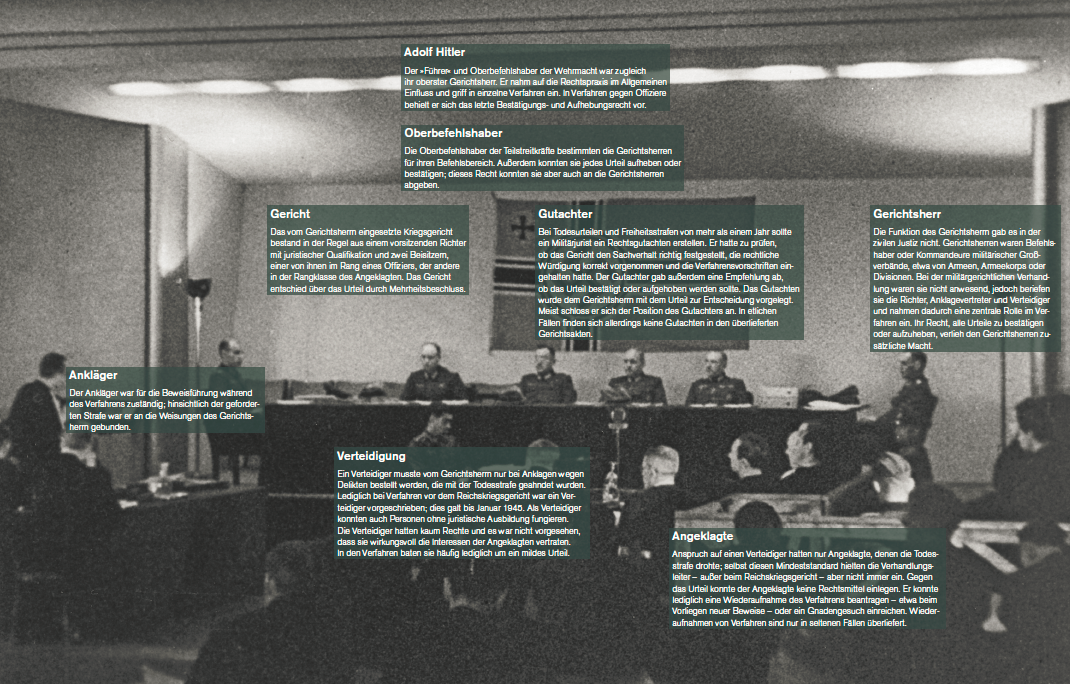
Übersicht: Rollen und Funktionen an Wehrmachtgerichten entlang den Bestimmungen der Kriegsstrafverfahrensordnung.
Quelle: Stiftung Denkmal für die ermordeten Juden Europas
Reasons for the Sentencing Record
Current research shows that most military judges willingly meted out harsh sentences. There are many reasons for this. For one, it is likely that they strongly agreed with the principles of the »Führer state« and the wartime objectives of the Nazi regime. As records show, careerism, peer pressure or judicial esprit de corps were more important that isolated qualms about the harsh sentences in demand. The course of the war too influenced the judgments: In order to avert the defeat that had been looming since 1943, Wehrmacht justice proceeded ever more brutally against »signs of disintegration«, regardless of whether it was a case at home or on the front.
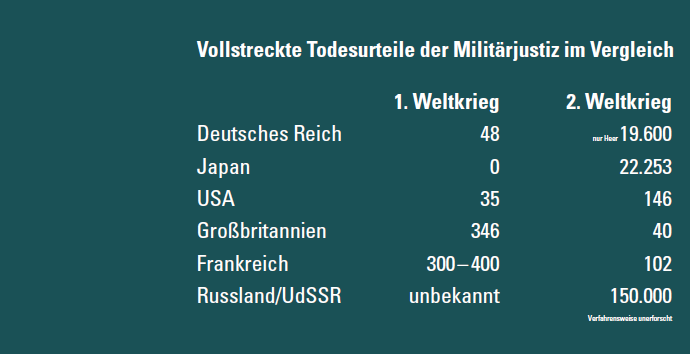
Tabelle Urteilsbilanz Militärjustiz im Ersten und Zweiten Weltkrieg
Quelle: Stiftung Denkmal für die ermordeten Juden Europas
Case Studies Wehrmacht Judges
The justice corps of the Wehrmacht has hardly been researched to date. It is estimated that there were between 200 and 300 Austrian judges among its ranks. Whether their specific legal practice differed from that of their »Reich German« colleagues is not known. By analogy with the research on attitudes and motivations of the approximately 1.3 million Austrians in the Wehrmacht, it is possible to assume that Austrian judges conformed to the war effort just as seamlessly as their armed comrades did.
The following examples of Austrian and German Wehrmacht judges (only available in german) illustrate a spectrum of functions, positions and possible courses of action. While Heinrich Hehnen, a conservative, German-national judge from Cologne, exemplifies a milder sentencing and assessing practice, Karl Everts from Vienna’s Division Court reveals a contrary course of action. Both were chief judges in their respective divisions, and both interpreted their tasks differently – the jurists were still left with argumentative leeway, despite the special situation caused by the war and the strict control by the often ruthless military supervision. It was even possible to use this leeway to the benefit of the defendants.
The presentation of Austrian judges shows that research on this theme is commencing in Austria. The case of Otto Tschadek serves as an example of both the sentencing practice and the personal and public discourse surrounding the topic during the Second Republic. Although his function as a navy judge was no secret, his apologetic and euphemistic self-appraising statements sufficed to positively depict both himself and all military judges from the »Third Reich« as people who had »fulfilled their duties« and served as defenders of the homeland.
Postwar
POSTWAR
The struggles over the aftermath of Wehrmacht jurisprudence in Austria (after decades of neglect) need to be considered against the background of a complex arrangement in the Second Republic concerning the assessment of National Socialism. On the one hand, the relevant political elites after 1945 considered Austria the victim of an aggressive and expansionist German Reich. According to this so-called victimhood thesis, a powerless Austrian state and population were annexed against their will, and soldiers incorporated into the Wehrmacht were forced to fight a brutal war; this led to widespread popular resistance. This strand of remembrance, which does not correspond to the historical facts, was complemented by a second narrative by the mid-1950s: the »discourse on duty«. According to this interpretation, the roughly 1.3 million Austrians in the Wehrmacht had fulfilled their patriotic duty and (valiantly) fought a war to defend their (Austrian) homeland, while contributing to the struggle against Bolshevism in Europe.
For these narratives of memory to become dominant, specific forms of forgetting were needed. Soon after the establishment of the Second Republic, this came at the cost of the actual victims of National Socialism: those persecuted for racist, political, religious and other reasons, including deserters and those »undermining the military forces« who had done the right thing according to the victimhood thesis – using their disobedience to resist tyranny. The goal of this strenuous historical-political effort was to pacify differences in the assessment of National Socialism and Austrofascism (1934 – 1938) especially between SPÖ and ÖVP, two political parties that often wound up forming coalition governments together.
Background
BESCHLUSS
The decision to erect the memorial in Vienna was part of an agreement reached by the social democratic/green coalition in 2010. In November of the following year, municipal department 7 (MA 7/culture) assembled a group of experts to discuss the project’s key points. Three subcommittees were tasked with developing a mission statement, deciding on a location, and making recommendations for the memorial’s use after its opening.
The first initiatives paying tribute to the Austrian victims of Nazi military justice were launched by the victims’ relatives. However, the grief they expressed through memorial stonesremained private out of shame or fear. In the 1990s, peacemovement activists organized the first political initiatives to commemorate deserters. At the turn of the millennium, a group of students from the University of Vienna first began researching the history of Nazi military jurisdiction. The Austrian Parliament then commissioned an in-depth study of the issue, which became the basis for future legislation. In October 2009, the Social Democratic Party, the People’s Party and the Green Party together passed the Repeal and Rehabilitation Law, sweepingly and comprehensively nullifying sentences issued by Wehrmacht courts. One year later, the municipal government of Vienna led by the Social Democratic Party and the Green Party decided to erect a memorial to deserters.


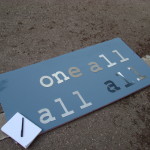

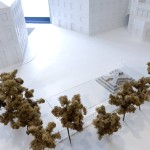
History of Persecution
HISTORY OF PERSECUTION
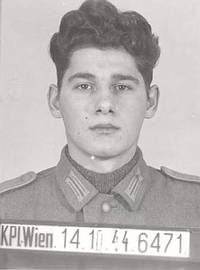
Karl Lauterbach, 1945 in Wien wegen Selbstverstümmelung hingerichtet
Austria became part of the German Reich in March 1938. Between 1939 and 1945, Germany and its allies spread a war of exploitation and extermination over Europe. By its end, some 35 million people had lost their lives.
Nazi military justice was an important instrument of war for the political and military leadership, which set off a flood of trials in order to thwart any deviation within the German army, the Wehrmacht. As the war progressed, the sentences issued by military judges became increasingly severe. Many of the sentences were suspended until after the war and replaced by »probation at the front«.
One Million Trials
In total, Nazi military courts conducted at least one million trials. Even minor offences frequently yielded long prison sentences. Many died in prison due to the harsh conditions, and there is only little research on how many soldiers perished while imprisoned or serving in penal units or other special units.
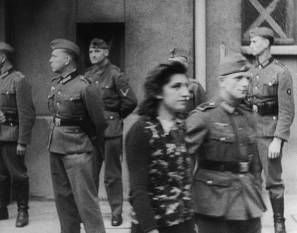
Simone Schloss, Mitglied einer kommunistischen Widerstandsgruppe bei einem Schauprozess vor einem deutschen Militärgericht in Paris 1942
German military justice also affected Austrian soldiers and civilians. Wehrmacht judges also tried allied prisoners of war. Between 7,000 and 10,000 death sentences were meted out to members of these two groups alone – it is not known exactly how many of the sentences were carried out.
15,000 Death Sentences Against Deserters
The dimensions of the verdict ratio become clear when comparing the way in which the largest group of convicts, the deserters, was dealt with: while Nazi military justice carried out death sentences against 15,000 deserters during World War II, the US Army carried out only one death sentence against a deserter between 1941 and 1946. The military justice of the armies in the German Empire (1871 – 1918) carried out a total of 18 death sentences against deserters.
Austro-Hungarian courts martial conducted about three million trials, meting out some 30,000 death sentences, particularly to civilians in Eastern and South Eastern Europe. Although the Austrofascist dictatorship (1933 –1938) did use the army to suppress the »internal enemy« (social democrats, communists and national socialists), it did not introduce an independent military justice to this purpose. Following Austria’s »Anschluss« (»annexation«) to Germany in March 1938, the Austrian army was incorporated into the GermanWehrmacht, taking on its military justice and code of criminal procedure.
Literaturhinweise
History of Persecution
Materialien
 Faltblatt “Das Denkmal für die Verfolgten der NS-Militärjustiz in Wien” auf Deutsch.
Faltblatt “Das Denkmal für die Verfolgten der NS-Militärjustiz in Wien” auf English.
Bezugsmöglichkeiten: Die in deutsch und englisch vorliegende Informationsbroschüre zum Denkmal kann u.a. auch über das Stadtinformationszentrum im Wiener Rathaus, das Dokumentationsarchiv des österreichischen Widerstands, die Österreichische Nationalbibliothek, das Wiener Stadt- und Landesarchiv, das Mauthausenkomitee Österreich, die Informationszentren von WienTourismus, über die Kunst im öffentlichen Raum (KÖR) sowie über die dem Denkmal jeweils direkt gegenüberliegende Präsidentschaftskanzlei in der Hofburg und das Bundeskanzleramt in gedruckter Form bezogen werden. Derzeit setzt sich das Personenkomitee auch für eine Box mit Flyern am Denkmal selbst ein.
Führungen, die das Denkmal für die Verfolgten der NS-Militärjustiz mit einbeziehen, können beim Mauthausenkomitee Österreich, bei den FremdenführerInnen von Guides in Vienna sowie über das Dokumentationsarchiv des österreichischen Widerstands gebucht werden.
Materialien zur politisch-historischen Bildung
Im folgenden stellen wir thematische Vertiefungen der Fallgeschichten verfolgter Soldaten und Zivilisten für die Bildungsarbeit zur Verfügung. Das Material ist gedacht für historisch Interessierte im Allgemeinen und ebenso als Handreichungen für LehrerInnen zur Vorbereitung des Unterrichts oder für Exkursionen zum Denkmal. Ausgearbeitet wurden Biografien von Menschen aus allen Teilen Österreichs und zudem von Angehörigen regionaler Minderheiten sowie europäischer Widerstandsbewegungen, die von Wehrmachtgerichten verfolgt wurden. Ziel der Auseinandersetzung mit den Materialien ist es,
- historisches Wissen über die Zeit des Nationalsozialismus und seine Nachgeschichte in der Zweiten Republik zu vermitteln
- die Bedeutung individueller Freiheitsrechte und demokratischer Grundwerte für jedeN Einzeln herauszustellen – damals wie heute
- und im Zusammenenhang damit die Leistungen und Leiden derer zu würdigen, die – aus welchen Gründen auch immer – Widerstand leisteten oder für sich Freiräume jenseits der herrschenden Normen reklamierten.
Angestrebt wird – entlang der im Lehrplan der Allgemeinbildenden Höheren Schulen formulierten Prinzipien – »ein an den Menschenrechten orientiertes Politik-und Demokratieverständnis zu erarbeiten«.
→ DOWNLOADS
Pädagogische Materialien/ ausführliche biografische Informationen zu den Verfolgten der NS-Militärjustiz
Thematische Einführung mit pädagogischen und didaktischen Handreichungen
Richard Wadani Fallgeschichte und Dokumente (PDF)
Fallgeschichte und Dokumente zu Maria Kacprzyk und Krystyna Wituska (Polen), verurteilt wegen Spionage und Feindbegünstigung (PDF)
Fallgeschichte und Dokumente zu Anton Tischler (Wien), verurteilt wegen Fahnenflucht (PDF)
Fallgeschichte und Dokumente zu Anton Brandhuber (Niederösterreich), verfolgt wegen Fahnenflucht (PDF)
- Fallgeschichte und Dokumente zu Maria Musial (Wien), verurteilt wegen Wehrkraftzersetzung (PDF)
- Fallgeschichte und Dokumente zu Alois Tiefengruber (Steiermark), verurteilt wegen Fahnenflucht (PDF)
- Fallgeschichte und Dokumente zu Erich Schiller (Niederösterreich), verurteilt wegen Fahnenflucht (PDF)
- Fallgeschichte und Dokumente zu Erwin Kohout (Oberösterreich), verurteilt wegen Fahnenflucht (PDF)
- Fallgeschichte und Dokumente zu Franz Severa (Wien), verurteilt wegen Fahnenflucht (PDF)
- Fallgeschichte und Dokumente zu Johann Kuso (Burgenland), verurteilt wegen Fahnenflucht (PDF)
- Fallgeschichte und Dokumente zu David Holzer (Tirol), verurteilt wegen Fahnenflucht (PDF)
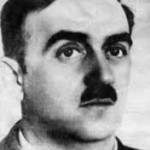 Fallgeschichte und Dokumente zu Anton Schmid (Wien), verurteilt wegen Feindbegünstigung (PDF)
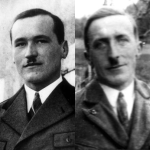
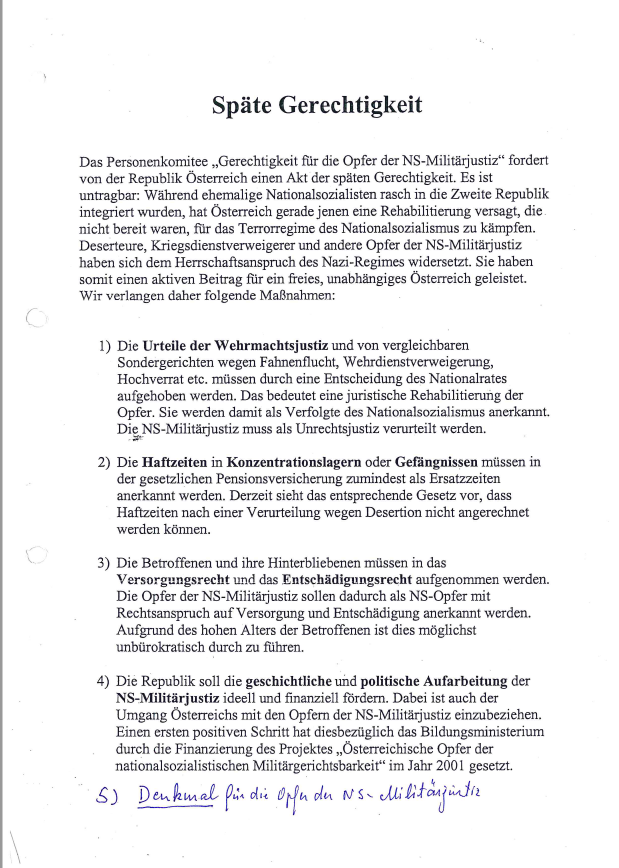
Denkmalstandort
»Die Fenster des schönen alten Palais am Ballhausplatz […] warfen oft noch spät abends Licht in die kahlen Bäume des gegenüberliegenden Gartens […]. Denn so wie der heilige Josef den gewöhnlichen Zimmermann Josef durchdringt, durchdrang der Name ‘der Ballhausplatz’ den dort stehenden Palast mit dem Geheimnis, eine des halben Dutzends mysteriöser Küchen zu sein, wo hinter verhängten Fenstern das Geschick er Menschheit bereitet wurde.« (Aus Robert Musil, Der Mann ohne Eigenschaften)
Ist in den Medien heute vom »Ballhausplatz« die Rede, so ist damit heute in der Regel das Bundeskanzleramt gemeint (bis 2005 auch das österreichische Außenministerium, das hier, mit kürzeren Unterbrechungen, mehr als 250 Jahre seinen Sitz hatte). Die Adresse Ballhausplatz 2 ist daher – analog zum Quai d’ Orsay in Paris oder der Downingstreet Nr. 10 – ein Synonym für die große Bühne nationaler wie internationaler Politik. Auf der dem Bundeskanzleramt gegenüberliegenden Seite des Ballhausplatzes, im Leopoldinischen Trakt der Hofburg, hat zudem seit 1946 der österreichische Bundespräsident seinen Sitz.
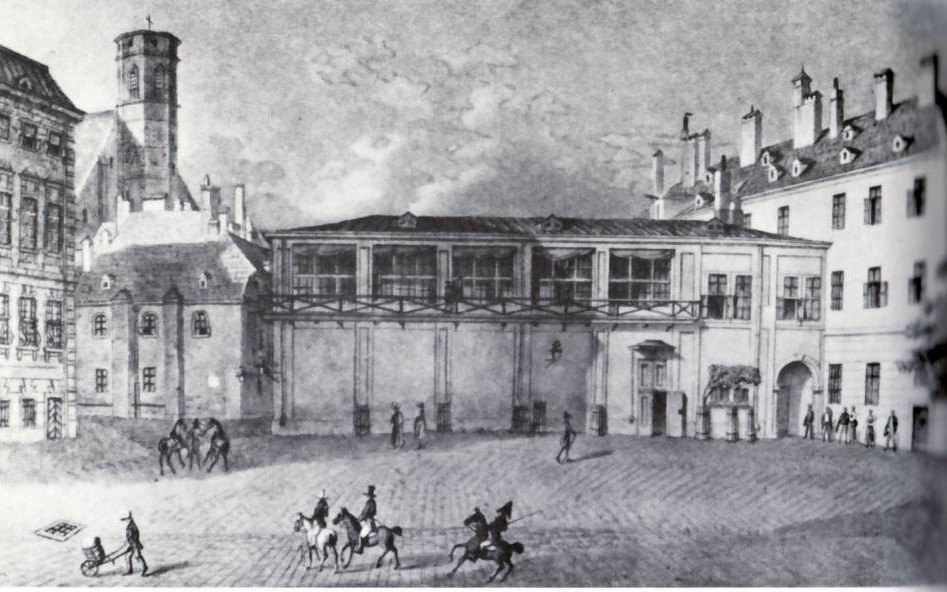
Blick aus Richtung Volksgarten auf den Ballhausplatz, um 1825. Links im Anschnitt die Staatskanzlei (heute Bundeskanzleramt), in der Bildmitte das Ballhaus, rechts der östliche Trakt des Hofspitals, nach einem anonymen Aquarell. Quelle: Schloss Schönbrunn, Kultur- und Betriegsgesellschaft mbh
Eine kurze Geschichte des Ballhausplatzes
Seinen Namen trägt der Ballhausplatz seit dem späten 18. Jahrhundert obwohl bereits rund 250 Jahre zuvor an dieser Stelle ein erstes Ballhaus entstanden war. Ferdinand I. von Habsburg hatte 1520 angeordnet, zur Zerstreuung des Hochadels, unweit der Hofburg, eine Halle für Ballspiele zu errichten. In den folgenden Jahrhunderten erfolgten nach Zerstörungen zwei Neuerrichtungen. Das Gebäude wurde bis Anfang des 20. Jahrhunderts für verschiedene Zwecke genutzt – unter anderem als Hofbauplatzkanzlei sowie als Kunstspeicher – und um 1903 abgerissen.
Anfang des 18. Jahrhunderts wurde am Ballhausplatz das bis heute erhaltene Gebäude nach den Plänen des Architekten Johann Lucas von Hildebrandt im barocken Stil errichtet. Der Bauplatz lag auf dem Areal des Hofspitals, dicht am damaligen Stadtwall und gegenüber der Hofburg. Es beherbergte die Geheime Hof- und Staatskanzlei nebst Archivräumen. Hier wurden seitdem die Hausangelegenheiten der Dynastie und Fragen der Außenpolitik bearbeitet – unter so namhaften Persönlichkeiten wie Clemens Graf Metternich und Felix Fürst zu Schwarzenberg. Die Hintertrakte grenzten schon damals an das Minoritenkloster. Im Kanzleigebäude am Ballhausplatz fand der Wiener Kongress (1814/15) statt, und hier versammelten sich im März 1848 revolutionäre Bürger, um gegen das Metternich’sche System der Restauration aufzubegehren. In den Räumen der Staatskanzlei am Ballhausplatz formulierten im Jahre 1914 k.u.k Beamte außerdem das Ultimatum an Serbien, das zum Ausgangspunkt des Ersten Weltkrieges werden sollte. Von einem Balkon desselben Gebäudes verkündete der letzte Außenminister Graf Andrássy gut vier Jahre später, am 29. Oktober 1918, die Auflösung des mit dem Deutschen Reich geschlossenen Bündnisses.
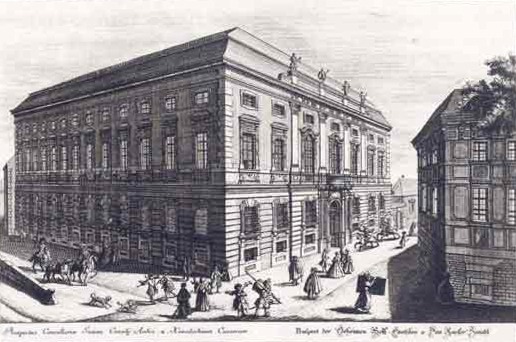
Die geheime Hof- und Staatskanzlei, um 1733. Das Gebäude wurde in den folgenden Jahren mehrfach umgestaltet, heute hat es eine fünfeckige Form. Rechts im Bild das Scalvinionische Haus (bis 1764), im Hintergrund rechts die Einfahrt zum Hofspital, Quelle: Federzeichnung von Salomon Kleiner
Doch auch nach Ende des Ersten Weltkrieges konzentrieren sich am Ballhausplatz zentrale staatliche Institutionen; die österreichischen Staats- bzw. Bundeskanzler (lange Zeit in Personalunion als Außenminister) und Bundespräsidenten residierten während der Ersten Republik wie auch zur Zeit des Austrofaschismus über weite Strecken in dem historischen Gebäude am Ballhausplatz. Insbesondere in der Endphase des Austrofaschismus wurden Heldenplatz und Ballhausplatz gemeinsam zum Ort für Aufmärsche und Demonstrationen der unterschiedlichen politischen Lager – gewissermaßen ein Vorgeschmack auf das, was am 15. März 1938, dem Tag der Verkündung des »Anschlusses« durch Adolf Hitler von der Hofburg aus geschehen sollte.
Doch bereits zuvor, am 25. Juli 1934, hatten sich am Ballhausplatz dramatische Ereignisse abgespielt, die auch baugeschichtlich Auswirkungen auf das dem Leopoldinischen Trakt der Hofburg gegenüberliegende Areal haben sollten. 154 verkleidete Angehörige der Wiener SS-Standarte 89 waren an diesem Tag zum Ballhausplatz aufgebrochen, um die austrofaschistische Regierung des Bundeskanzlers Dollfuß gefangen zu nehmen.
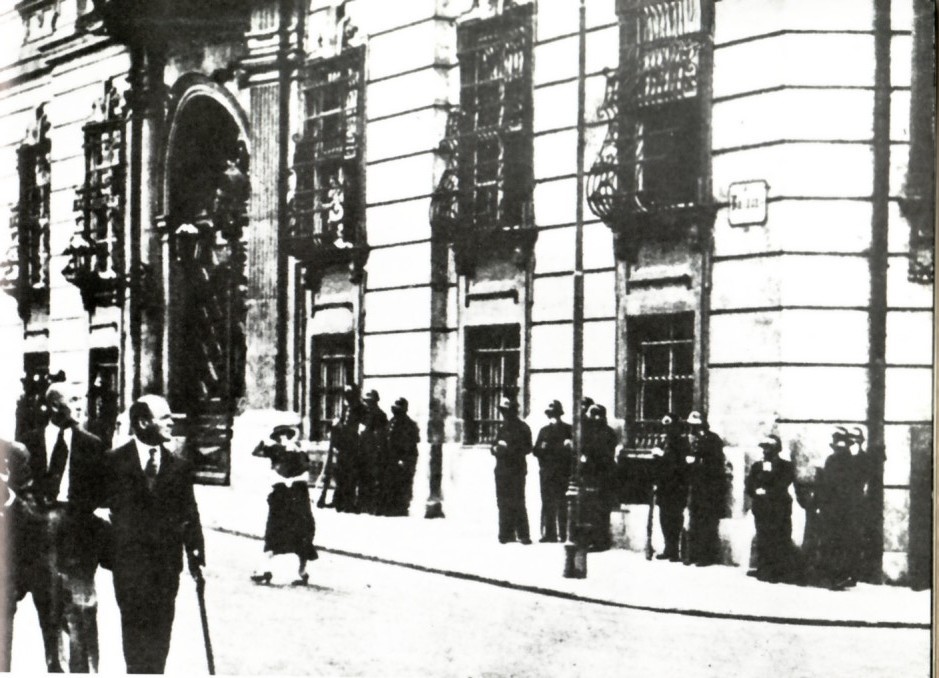
Belagerungszustand am Ballhausplatz, Juli 1934
Der Ausgang der Geschichte ist bekannt: Bundeskanzler Engelbert Dollfuß wurde im »Grauen Ecksalon« des Kanzleramtes von dem nationalsozialistischen Attentäter Otto Planetta erschossen. Am Abend des 11. März 1938, also am Vorabend des Einmarschs der Wehrmacht auf österreichisches Staatsgebiet, begrüßte der von Bundespräsident Wilhelm Miklas für eine neue Regierungsbildung beauftragte bisherige Innenminster Arthur Seyß-Inquart vom Balkon des Kanzleramtes herab seine nationalsozialistischen Anhänger. Zwar wählte im Sommer 1940 der Gauleiter und Reichsstatthalter von Wien Baldur von Schirach seinen Sitz wieder am Ballhausplatz; dies sollte dies jedoch eine bis heute fast vergessene Episode bleiben. Der Ballhausplatz wurde vom »politischen Machtzentrum zu einer Liquidationsstelle für die zu einem Schattendasein absinkende ‘österreichische Landesregierung’«[1]

Schema des Ballhausplatzbereichs. / Quelle: Wandruszka, Adam; Reininghaus, Mariella: Der Ballhausplatz. Wiener Geschichtsbücher, hg. von Peter Pötschner, Bd. 33, Wien 1984, S. 93.
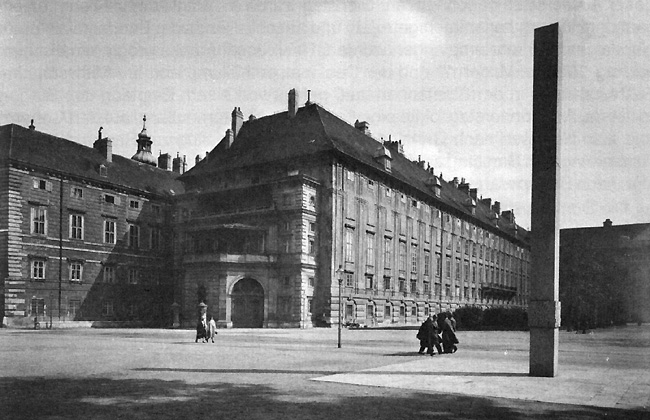
Blick auf das Otto-Wagner-Denkmal auf dem Heldenplatz (unmittelbar neben dem aktuellen Denkmalstandort), Anfang der 1930er Jahre. / Quelle: www.viennatouristguide.at
Der Ballhausplatz als historischer Denkmalstandort
Am Ballhausplatz, genauer, auf einem rechteckigen Rücksprung am südwestlichen Rand des Volksgartens, wurde am 24. Oktober 2014 auf Beschluss der Wiener rot-grünen Koalition das Denkmal zur Erinnerung an die Verfolgten der NS-Militärjustiz eröffnet. Bereits zweimal seit 1930 ist dieses und das unmittelbar angrenzende Areal Standort eines Denkmals gewesen. Zwischen 1930 und 1937 fand sich dort eine Steinsäule in Erinnerung an den Wiener Architekten Otto Wagner.

Siegreicher Denkmalsentwurf von Holzmeister/Andre. Quelle: profil, Österreichische Monatsschrift für bildende Kunst, 4/1936, Heft 10, S.444/445
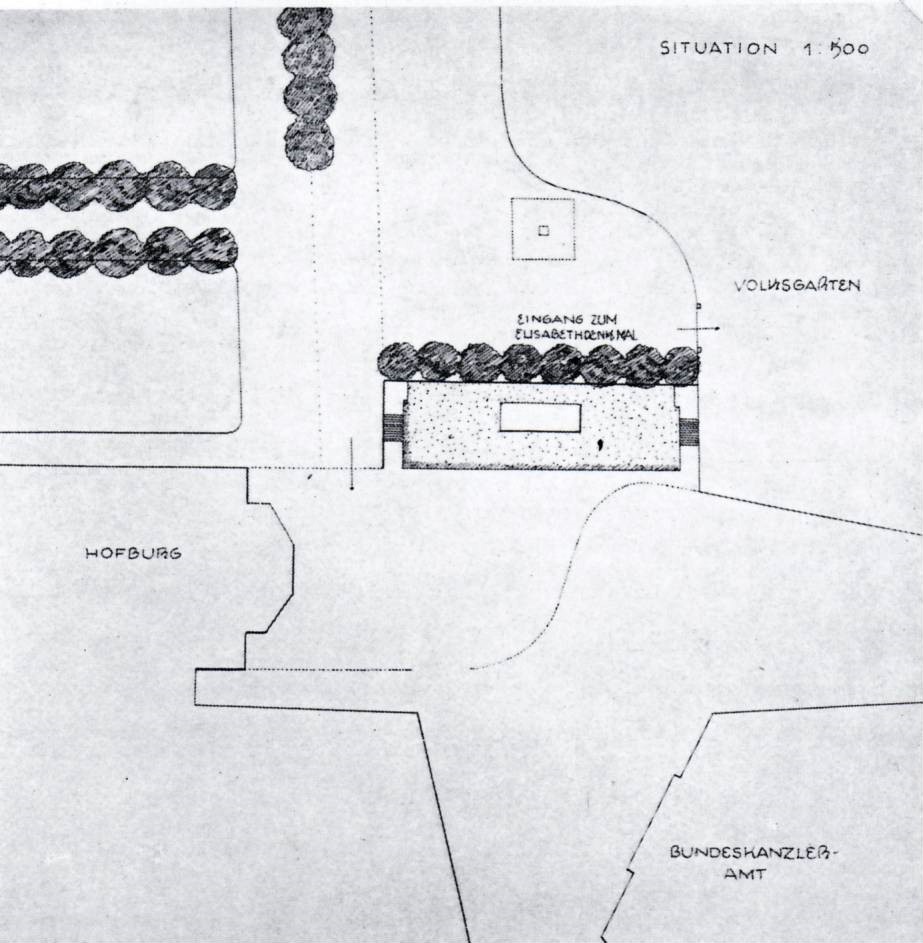
Übersichtsskizze Denkmalstandort von Holzmeister/Andre. / Quelle: profil, Österreichische Monatsschrift für bildende Kunst, 4/1936, Heft 10, S.444/445
Das Denkmal bestand aus einem Steinblock mit den Maßen 10 x 3, 50 x 2, 33 m, der auf einem 2, 50 m hohen Unterbau ruhte. Darauf sollten die eingemeißelten Bilder des ermordeten Bundeskanzlers inmitten der österreichischen Jugend sowie – in schematischer Darstellung – der Stände und der Familie zu sehen sein. Der Denkmalblock sollte in einer von Mauern umgebenen Vertiefung stehen, Treppenanlagen den Zugang ermöglichen. Am 18. Oktober 1936 weihte der Wiener Kardinal Theodor Innitzer diesen und am selben Tag auch den Grundstein einer »Dollfuß-Führerschule« im 15. Wiener Gemeindebezirk (ebenfalls nach Entwürfen von Clemens Holzmeister).
Die Entwürfe indes kamen niemals zur Ausführung, das »Dollfuß-Nationaldenkmal« ebenso wenig wie ein am östlichen Rand des Ballhausplatzes (in den »Ballhausplatzgründen«) projektiertes »Haus der Vaterländischen Front«. Zwar war bereits ein Steinblock gesetzt worden am Ort des heutigen Standortes des Denkmals für die Verfolgten der NS-Militärjustiz; lediglich die Bildhauerarbeiten Hans Andres‘ fehlten noch. Der »Anschluss« im Frühjahr 1938 und die Übernahme der Regierung durch die Nationalsozialisten beendeten alle Planungen, die fertig gestellten Teile des Denkmals wurden schnell wieder entfernt.
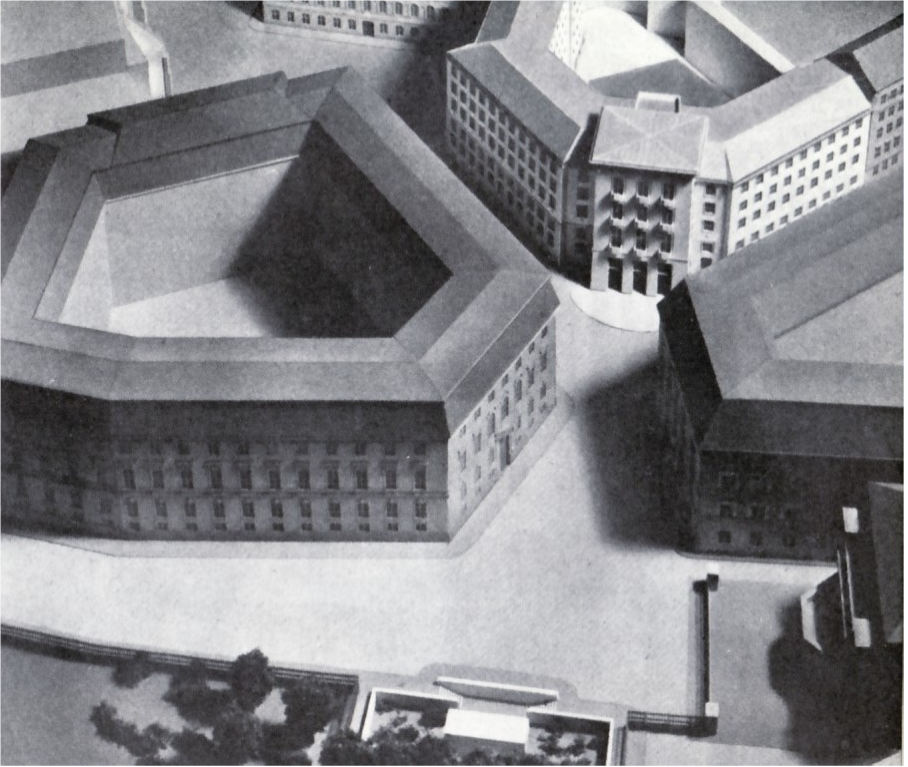
Der Ballhausplatz mit geplanten »Haus der Vaterländischen Front«, oben rechts und Dollfuß-Nationaldenkmal, unten Mitte, Modell von Clemens Holzmeister von 1937.
Stattdessen brachten die neuen Machthaber an der Außenseite des Bundeskanzleramtes eine Gedenktafel für die »154 deutschen Männer« an, die dort am 25. Juli 1934 »für Deutschland« gehandelt hätten. Der Dollfuß-Attentäter Otto Planetta war nach dem Mord verhaftet und am 31. Juli 1934 im Wiener Landesgericht hingerichtet worden. Die Nationalsozialisten stilisierten ihn in den folgenden Jahren zum »ostmärkischen Freiheitshelden«. Bis 1944 fanden jährlich am 25. Juli Prozessionen zum Ballhausplatz statt, die Gedenktafel für Planetta wurde unmittelbar nach Kriegsende entfernt. Im Bundeskanzleramt erinnert bis heute eine Inschrift im Fußboden des »Grauen Ecksalons« an den Mord an Engelbert Dollfuß. Bis 2006 gab es im Gebäude noch eine kleine Gedenkstätte mit Portraitfoto und Kerze am Tatort, bis 2010 noch einen jährlichen Gedenkgottesdienst in der Amtskapelle am Ballhausplatz.
Seit 1937/1938 ist der Ort also nicht mehr für Denkmäler genutzt worden. Seit den Zeiten der schwarz-blauen Koalition (2000-2007) diente die Fläche als Park- und Abstellplatz für Einsatzfahrzeuge bzw. Absperrgitter, die anlässlich von Großveranstaltungen oder Staatsbesuchen auf dem Heldenplatz benötigt wurden. Auf der seit 1995 alljährlich durch das Bundesheer abgehaltenen »Informations- und Leistungsschau« am Nationalfeiertag auf dem Heldenplatz wurde das künftige Denkmalareal auf dem Ballhausplatz ebenfalls als Abstellfläche genutzt.
Inhaltliche Gründe für die Wahl des Ballhausplatzes als Denkmalstandort
Angesichts der oben kurz zusammengefassten historischen Ereignisse rund um den Denkmalstandort am Ballhausplatz seien hier die wichtigsten Kriterien für seine thematische Eignung zusammengefasst. Die Entscheidung für diesen Ort war von intensiven inhaltlichen und politischen Diskussionen begleitet, was sich auch in der medialen Berichterstattung widerspiegelte:
- Heldenplatz und Ballhausplatz sind von der räumlichen Wahrnehmung her kaum voneinander zu trennen, sie gehen ineinander über. Beide Areale sind also mindestens im Sinne der dort verhandelten Präsentation staatlicher Macht eng verknüpft – und damit auch ihre Bedeutung für die hier noch immer präsenten Themenkomplexe Krieg, »Heldentum«, Militär und Opfergedenken.
- Vom Ballhausplatz aus besteht eine Sichtbeziehung zu dem Balkon in der »Neuen Burg«, von dem aus Adolf Hitler am 15. März 1938 den »Anschluss« Österreichs an das Deutsche Reich erklärte. Nur ein Jahr später begann die Wehrmacht einen beispiellosen Angriffs- und Vernichtungskrieg, der rund 50 Millionen Menschen das Leben kostete. Die Verfolgten einer verbrecherischen Wehrmachtjustiz zählen zu den Opfern dieser verbrecherischen Kriegführung. Aufgrund der besonders hohen Zahl hingerichteter Deserteure ist das Denkmal in starkem Maße auch ihnen gewidmet und ihren ganz spezifischen Entscheidungen, sich – wenn auch nicht immer bewusst und im Sinne einer höheren politischen Moral – einem verbrecherischen Krieg zu verweigern; insofern setzt das Denkmal an diesem zentralen und geschichtsträchtigen Ort ein Fragezeichen hinter Konzepte absoluten Gehorsams und autoritärer Gewalt.
- Am Ballhausplatz konzentrier(t)en sich wichtige staatliche Institutionen der Exekutive – im historischen wie im gegenwärtigen Österreich. Jeder Staatsgast passiert das Denkmal; der Ort bietet eine exzellente Möglichkeit, um die Abkehr von den Zielen und Mitteln eines verbrecherischen Staates deutlich zu machen, zu dem Österreich zwischen 1938 und 1945 gehörte. Hier kann vergangenheitspolitisch klar Position bezogen und damit ein Bekenntnis zu Rechtsstaatlichkeit, Friedfertigkeit und Zivilcourage abgelegt werden.
- In unmittelbarer Nachbarschaft zum Ballhausplatz, in der Krypta am Äußeren Burgtor, gedenkt die Republik Österreich bis heute seiner »Kriegshelden« – auch wenn diese Gedenkpraxis zur Zeit einer eingehenden Prüfung unterzogen wird (Stand Januar 2018). In diese Richtung einer Konservierung militärischer Traditionen weisen auch die Reiterstandbilder für Erzherzog Karl und den Prinzen Eugen auf dem Heldenplatz. Ein in Sichtweite errichtetes Denkmal für die Verfolgten der NS-Militärjustiz am Ballhausplatz sollte dort als Gegenentwurf verstanden werden zum Handeln gehorsamer (österreichischer) Wehrmachtssoldaten, die, wie es (Stand Januar 2018) in einer offenbar zeitlos verstandenen Widmung in der Krypta sinngemäß heißt, »in Erfüllung Ihres Auftrages ihr Leben ließen«. Dagegen zu setzen wäre der Satz von Elfriede Jelinek: »Wir können nicht wissen, wie wir uns damals verhalten hätten, aber wir wissen, wie wir uns verhalten hätten sollen«
[1] Wandruszka, Adam; Reininghaus, Mariella: Der Ballhausplatz. Wiener Geschichtsbücher, hg. von Peter Pötschner, Bd. 33, Wien 1984, S. 100.
Weiterführende links zum Ballhausplatz
- Architektenlexikon (Eintrag Hermann Stiegholzer) zum Wettbewerb für das Dollfuß-Nationaldenkmal
- Bilder zum Ballhausplatz
Literatur
- Ackerl, Isabella (Red.): Wien Ballhausplatz 2. Ein Haus und seine Geschichte, Wien 2001.
- Brait, Andrea: Das Bundeskanzleramt in Wien. Ein österreichischer Gedächtnisort. Hamburg 2010.
- Das Dollfuß-Nationaldenkmal auf dem Ballhausplatz in Wien. In: Profil. Österreichische Monatsschrift für bildende Kunst, 4/1936, H.10, S.444f.
- Bundespressdienst (Hg.): Schicksal eines Hauses. Wien, Ballhausplatz 2, Wien 1977.
- Engel-Janosi, Friedrich: Geschichte auf dem Ballhausplatz, Essays zur österreichischen Außenpolitik, Wien 1963.
- Grassegger, Friedrich: Denkmäler des autoritären Ständestaates. Repräsentation staatlicher und nationaler Identität Österreichs 1934-1938. In: Ders. (Hg.): Steinernes Bewusstsein I. Die öffentliche Repräsentation staatlicher und nationaler Identität Österreichs in seinen Denkmälern, Wien/Köln/Weimar 1998, S. 495-546.
- Grassegger, Friedrich: Nationalsozialistische Denkmäler in Österreich. Denkmalspuren der NS-Herrschaft und die Frage nach der österreichischen Identität (1938-1945). In: Ders. (Hg.): Steinernes Bewusstsein I. Die öffentliche Repräsentation staatlicher und nationaler Identität Österreichs in seinen Denkmälern, Wien / Köln /Weimar 1998, S. 547-573.
- Holzbauer, Wilhelm: Das ungebaute Wien. 1800 bis 2000. Projekte für die Metropole, Katalog für die Sonderausstellung des Historischen Museums Wien, Wien 2000.
- Hufschmied, Richard; Rathkolb, Oliver (Hg.): Mehrfach gewendet: Eine historisch-künstlerische Collage der Schlüsseljahre 1918 / 1938 / 1945 / 1955. Präsidentschaftskanzlei, Hofburg, Ballhausplatz. 26. 10. 2008, Wien 2008.
- Kellerhoff, Sven Felix: Schüsse am Ballhausplatz. Der Putsch gegen Österreichs Kanzler Dollfuß 1934. In: Demandt, Alexander (Hg.): Das Attentat in der Geschichte, Wien/Köln 1996, S. 345-366.
- Reiter-Zatloukal, Ilse; Rothländer, Christiane; Schölnberger, Pia (Hg.): Österreich 1933–1938. Interdisziplinäre Annäherungen an das Dollfuß-/Schuschnigg-Regime, Wien 2012.
- Stachel, Peter: Signs and the City. Meaning and Function of »Heroes Squares« in Centrale Europe, In: Barbara Lášticová, Sophie Wahnich, Andrej Findor (Hg.), Politics of Collective Memory. Cultural Patterns of Commemorative Practices in Post-War Europe, Wien/Berlin 2008, S. 69-91.
- Stachel, Peter: Der Heldenplatz. Zur Semiotik eines österreichischen Gedächtnis-Ortes. In: Riesenfellner, Stefan (Hg.): Steinernes Bewusstsein I. Die öffentliche Repräsentation staatlicher und nationaler Identität Österreichs in seinen Denkmälern, Wien/Köln/Weimar 1998, S. 619-656.
- Wandruszka, Adam; Reininghaus, Mariella: Der Ballhausplatz. Wiener Geschichtsbücher, hg. von Peter Pötschner, Bd. 33, Wien 1984.
Ausgewählte Berichterstattung zur Standortentscheidung am Ballhausplatz
- Deserteursdenkmal: Künstler gesucht. In: ORF, 29. November 2012.
- Deserteursdenkmal: Zeitrahmen bekannt gegeben. In: derStandard.at, 29. November 2012.
- Künstler für Wiener Deseteursdenkmal soll im Sommer feststehen. In: viennaonline.at, 29. November 2012.
- Deserteursdenkmal: Stadt Wien zahlt 220.000 Euro. In: DiePresse.com, 27. November 2012.
- Bethany Bell: Austrian Deserter’s Memorial at the Ballhausplatz. In: BBC, 27. November 2012. (Zeit-Code: 38:45)
- Manfried Rauchensteiner: Wem gehört, was war? In: DiePresse.com, 9. November 2012.
- Julia Druelle: Les déserteurs de la Wehrmacht, une controverse autrichienne. In: Le Monde, 3. November 2012.
- Andreas Koller: Eingeholt von der Geschichte. In: Salzburger Nachrichten, 27. Oktober 2012.
- Rudolf Langthaler: Was wir Deserteuren wirklich schuldig sind. In: derStandard.at, 26. Oktober 2012.
- Andreas Koller: Ein Platz für NS-Deserteure. In: Salzburger Nachrichten, 13. Oktober 2012.
- Josef Gebhardt: Eine späte Ehre für Deserteure. In: Kurier, 13. Oktober 2012.
- Deserteursdenkmal auf dem Ballhausplatz. In: ORF, 12. Oktober 2012.
- Deserteursdenkmal: Ballhausplatz als Standort fix. In: Kronenzeitung, 12. Oktober 2012.
- Deserteursdenkmal: Umsetzung durch KÖR am Ballhausplatz. In: OTS-Meldung vom 12. Oktober 2012.
- Peter Mayr: Deserteursdenkmal: Historische Richtigstellung. In: derStandard.at, 12. Oktober 2012.
- Andreas Koller, 90 Jahre Leben für ein Denkmal. In: Salzburger Nachrichten, 1. Oktober 2012.